Türkiye'nin Bitlis Yöresinde İnsanlara Tutunan Kene Türlerinin Belirlenmesine Yönelik Ön Bir Çalışma
Cilt 29, Sayı 1
Şubat 2015 · Sayfalar 019-021
Türkiye'nin Bitlis Yöresinde İnsanlara Tutunan Kene Türlerinin Belirlenmesine Yönelik Ön Bir Çalışma
A Preliminary Study for Determining Tick Species Attached Humans in Bitlis Province of Turkey
Mehmet Fatih AYDIN1
1Karamanoğlu Mehmetbey Üniversitesi, Sağlık Yüksekokulu, Karaman, TÜRKİYE
Anahtar Kelimeler:KeneinsanBitlisTürkiye
Keywords:TickhumanBitlisTurkey
Bu çalışma 2009 yılı Mayıs ve Ağustos ayları arasında Türkiye'nin Doğu Anadolu bölgesindeki
Bitlis Devlet Hastanesinin Acil Servisine kene tutunma şikâyetiyle başvuran 91 hastadan çıkartılan
kene türlerini rapor etmektedir. Keneler hastalardan acil serviste çıkartılmış ve % 70'lik etanol
içeren tüplerde saklanmıştır. Kenelerin stereo mikroskop altında morfolojik özelliklerine göre tür
teşhisleri yapılmıştır. İnceleme sonucu belirlenen dokuz kene türü şu şekildedir: Rhipicephalus
bursa (18/91), Dermacentor marginatus (15/91), Hyalomma anatolicum (12/91), Hyalomma
aegyptium (9/91), Haemaphysalis sulcata (9/91), Hyalomma marginatum (6/91), Hyalomma
excavatum (6/91), Rhipicephalus sanguineus group (6/91), Haemaphysalis spp. (3/91) ve
Hyalomma rufipes (1/91). Buna ek olarak iki Rhipicephalus sp. nimfi ve dört Hyalomma sp. nimfi
belirlenmiştir. Bu sonuçlar Bitlis yöresinde insanları enfeste eden kene türleri ile için ilk bilgileri
sağlamaktadır. Türkiye'de ve dünya çapında, insanlar ile evcil ve vahşi hayvanları enfeste eden
kene türlerinin belirlenmesine yönelik ileri çalışmalara ihtiyaç duyulmaktadır.
This study reports tick species removed from 91 patients who complained of tick bite between May
and August 2009 in the Emergency Service of Bitlis State Hospital located in Eastern Anatolian
region of Turkey. Ticks were detached from the patients in Emergency service and stored in tubes
containing 70% ethanol. Ticks were diagnosed under a stereo microscope according to the
morphological features. As a result of the investigation, nine tick species were identified as follows:
Rhipicephalus bursa (18/91), Dermacentor marginatus (15/91), Hyalomma anatolicum (12/91),
Hyalomma aegyptium (9/91), Haemaphysalis sulcata (9/91), Hyalomma marginatum (6/91),
Hyalomma excavatum (6/91), Rhipicephalus sanguineus group (6/91), Haemaphysalis spp. (3/91)
and Hyalomma rufipes (1/91). In addition to this two Rhipicephalus sp. nymhs and four Hyalomma
sp. nymhs were identified. These results provide first data for tick species infesting humans in Bitlis
province. Further studies are required to determine which tick species are infesting humans and
domestic-wild animals in Turkey, and also throughout the world.
Giriş
Ticks are obligate hematophagous arthropods that parasitize every class of
vertebrates in almost every region of the world. Ticks can cause anemia, toxication,
paralysis, irritation, allergies, and secondary infection because of skin lesions. Ticks are
biological and mechanical vectors of viral, bacterial, rickettsial, spirochetal, protozoal,
and helmintic diseases[1-3].
There are two major tick families; Ixodidae or hard ticks, Argasidae, or soft ticks. A
third family, the Nuttalliellidae, is represented by only a single species that is confined to
southern Africa. In the world, 907 species (Ixodidae: 720, Argasidae: 186, Nuttalliellidae:
1) of ticks have been recorded[4]. Also, 32 tick species in two families on human and
animals had been detected in Turkey[5,6].
Ticks can transmit approximately 200 diseases to humans and animals. One of the
tick transmitted diseases is Crimean-Congo hemorrhagic fever (CCHF) virus is
transmitted to humans by ticks of the genus Hyalomma, but also through direct contact
with blood or tissues of viraemic hosts. It is characterized by extensive ecchymosis,
visceral bleeding, and hepatic dysfunction. The disease is endemic in parts of Africa,
Asia, the Middle East, and Eastern Europe. Crimean-Congo hemorrhagic fever is an
important public health issue in Turkey because of its high mortality rate and distribution[7].
Ticks and tick-borne diseases possess a great importance in Turkey from past to
present. It is important to determine tick species on host and environment. This study
aims to determine tick species detached from patients who complained tick bite in
Emergency service in State Hospital in Bitlis province of Turkey.
Gereç ve Yöntem
The ticks were obtained from 91 patients who
complained of tick bite in the Emergency Department of
Bitlis State Hospital located in the Bitlis province of
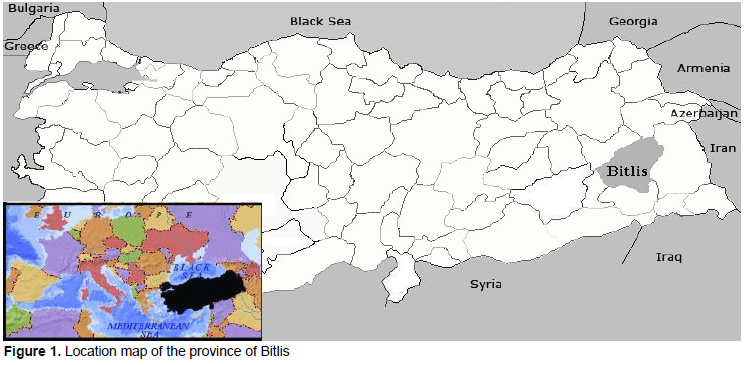
Turkey between May and August 2009 (Figure 1). The
ticks were removed from the patient's body by physicians
and stored in tubes containing 70% ethanol. They were
identified under a stereo microscope (Olympus SZX16)
by its morphological features[8,9].
Figure 1: Location map of the province of Bitlis
Bulgular
All humans were found to be infected by one tick
species and 91 ticks were collected during the study.
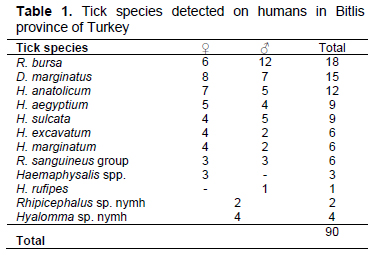
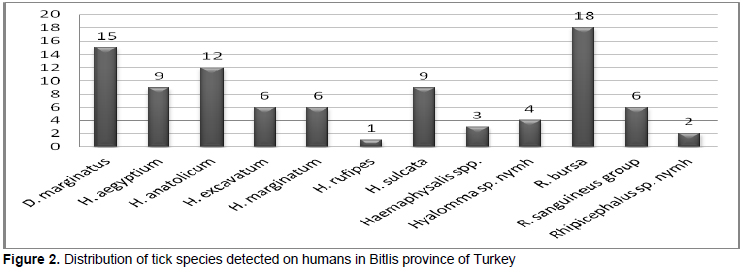
Nine tick species were identified as follows: R. bursa
(18/91), D. marginatus (15/91), H. anatolicum (12/91), H.
aegyptium (9/91), H. sulcata (9/91), H. marginatum
(6/91), H. excavatum (6/91), R. sanguineus group (6/91),
Haemaphysalis spp. (3/91) and H. rufipes (1/91). In addition to this two Rhipicephalus sp. nymhs and four
Hyalomma sp. nymhs were collected (Table 1, Figure 2).
Table 1: Tick species detected on humans in Bitlis
province of Turkey
Figure 2: Distribution of tick species detected on humans in Bitlis province of Turkey
Tartışma
In Turkey some studies have been conducted on tick
infestation on humans. As a result of these studies; in
Thrace province: H. marginatum, H. aegyptium, H.
detritum, Ixodes ricinus R. sanguineus group, R. bursa,
Haemaphysalis parva, Haemaphysalis punctata, H.
sulcata, D. marginatus, Ornithodoros sp. and Argas sp.[10]; in Istanbul province: I. ricinus, H. marginatum, H.
aegyptium, H. detritum, R. bursa, R. sanguineus and D.
marginatus[11]; in central Black Sea region: H.
marginatum, H. detritum, H. excavatum, H. anatolicum,
R. bursa, Rhipicephalus turanicus, D. marginatus, I.
ricinus and H. punctata[12]; in Aydın province: H.
aegyptium, H. anatolicum, Hyalomma scupense, H.
excavatum, H. marginatum, H. rufipes, Rhipicephalus
(Boophilus) annulatus, R. bursa, R.sanguineus,
R.turanicus, D. marginatus, I. ricinus and H. parva were
determined[13]. Our results consistent with the previous
studies and also these results are the first record for tick
species in Bitlis province.
In Turkey 7 Hyalomma species [H. anatolicum, H.
excavatum, H. marginatum, H. detritum, Hyalomma dromedarii, H. rufipes, and H. aegyptium] have been
recorded[5,14]. However, the presence of H. rufipes
has only been recorded rarely in Turkey, in Eastern
Anatolia[15]. Recently, H. rufipes was detected on cattle
in the West Aegean and South Marmara region[16,17]
and on human in Aydın province of Turkey[13].
Hyalomma rufipes transmit a variety of protozoal,
bacterial and viral agents, such as the CCHF virus,
Anaplasma marginale, Rickettsia conorii, and Babesia
occultans[8].
In conclusion, this is a preliminary data reported for
tick species for humans in the Bitlis province. These
results are the first data for tick species in the province.
Further studies are warranted for ticks and people should
be trained about ticks and tick-borne diseases in the
province and thorough the Turkey.
Acknowledgement
We thank all the health workers and the staff of the
Emergency Service and Microbiology Laboratory of Bitlis
State Hospital.
References
Jongejan F, Uilenberg G. The global importance of ticks.
Parasitology 2004; 129: 3-14.
Aktas M, Vatansever Z, Altay K, Aydin MF, Dumanli N.
Molecular evidence for Anaplasma phagocytophilium in
Ixodes ricinus from Turkey. Trans R Soc Trop Med Hyg
2010; 104: 10-15.
Aydin MF, Aktas M, Dumanli N. Molecular identification of
Theileria and Babesia in ticks collected from sheep and
goats in the Black Sea region of Turkey. Parasitol Res
2015; 114: 65-69.
Horak IG, Camicas JL, Keirans JE. The Argasidae,
Ixodidae and Nuttalliellidae (Acari: Ixodidae): A world list of
valid tick names. Exp App Acaro 2002; 28: 27-54.
Aydin L, Bakirci S. Geographical distribution of ticks in
Turkey. Parasitol Res 2007; 101: 163-166.
Dumanlı N, Altay K, Aydin MF. Tick species of cattle,
sheep and goats in Turkey. Turkiye Klinikleri J Vet Sci
2012; 3: 67-72.
Estrada-Pena A, Bouattour A, Camicas JL, Walker AR.
Ticks of Domestic Animals in the Mediterranean Region: A
Guide to Identification of Species. 1st Edition, Zaragoza:
Spain, 2004.
Merdivenci A. Türkiye Keneleri Üzerine Araştırmalar. 1.
Baskı, İstanbul: Kutulmuş Matbaası, 1969.
Gargili A, Kar S, Yılmazer N, et al. Evaluation of ticks biting
humans in Thrace Province, Turkey. Kafkas Univ Vet Fak
Derg 2010; 16(A): 141-146.
Vatansever Z, Gargili A, Aysul NS, et al. Ticks biting
humans in the urban area of Istanbul. Parasitol Res 2008;
102: 551-553.
Umur S, Hokelek M, Acici M, Gurler AT, Beyhan YE. Orta
Karadeniz Bölgesinde İnsanlarda Isırık Şikayetiyle Getirilen
Kene Türleri. XV. Ulusal Parazitoloji Kongresi. Kayseri /
Ürgüp, 18-23 Kasım 2007.
Bakirci S, Aysul N, Eren H, Unlu AH, Karagenc T. Diversity
of ticks biting humans in Aydın province of Turkey Ankara
Üniv Vet Fak Derg 2014; 61: 93-98.
Aydin MF, Aktas M, Dumanli N. Tick infestations on sheep
and goats in the Black Sea Region of Türkiye. Kafkas Univ
Vet Fak Derg 2012; 18(Suppl-A): A17-A22.
Hoogstraal H. African Ixodoidea. I Ticks of the Sudan. U.S.
Naval Medical Research No: 3. Egypt: Unit Cairo, 1956.
Bakirci S, Sarali H, Aydin L, et al. Hyalomma rufipes (Koch,
1844) infesting cattle in the West Aegean region of Turkey.
Turk J Vet Anim Sci 2011; 35: 359-363.
Yesilbag K, Aydin L, Dincer E, et al. Tick survey and
detection of Crimean-Congo hemorrhagic fever virus in tick
species from a non-endemic area, South Marmara region,
Turkey. Exp Appl Acarol 2013; 60: 253-261.