
Kıl Yiyen Manda Yavrularında Oksidatif Stresin Değerlendirilmesi
Cilt 36, Sayı 2
Haziran 2022 · Sayfalar 112-115
Kıl Yiyen Manda Yavrularında Oksidatif Stresin Değerlendirilmesi
Assessment of Oxidative Stress in Hair-Eating Buffalo Calves
Aynur ŞİMŞEK1, Akın KOÇHAN1, Ayşe EKİNCİ YILDIZ2, İlhan SABANCILAR3
2Dicle University, Health Sciences Institute, Department of Internal Medicine, Diyarbakır, TÜRKİYE
3Dicle University, Health Sciences Institute, Department of Biochemistry, Diyarbakır, TÜRKİYE
Pika yem niteliğinde olmayan tahta parçaları, toprak, kemik ve kıl gibi maddelerin yenilmesi olarak tanımlanmaktadır. Kıl yeme hastalığı olan hayvanlar kendi vücutlarındaki veya diğer hayvanların vücutlarındaki kılları ısırıp kopararak deride alopecia ve yaralanmalara neden olabilirler. Bu araştırmada birbirlerinin kıllarını yiyen manda yavrularında total antiokidan durum (TAS), total oksidan durum (TOS) ve oksidatif stres indeksi (OSI) düzeylerinin araştırılması amaçlandı. Çalışmanın materyalini 110 başlık manda sürüsünde bulunan, 1-6 aylık yaşlarda, kıl yeme semptomu gösteren 22 manda yavrusu (Grup 1) ile kıl yeme semptomu olmayan ve herhangi bir hastalık belirtisi göstermeyen 6 manda yavrusu (Grup 2) olmak üzere toplam 28 hayvan oluşturdu. TAS, TOS ve OSI seviyelerini ölçmek için hayvanların vena jugularislerinden kan örnekleri alındı. Hasta hayvanların serum ortalama TOS ve OSI seviyelerinin kontrol grubuna göre önemli düzeyde yüksek olduğu tespit edildi. Sonuç olarak, kıl yeme semptomlu manda yavrularında oksidatif/antioksidatif dengenin oksidatif yöne kaydığı tespit edilmiştir.
Pica is defined as the appetite of the animals for non-feed substances, such as wood pieces, soil, bone, or hair. Animals with hair-eating disorders can bite and pluck hair from their bodies or other animals, causing alopecia and skin injuries. In the present study, it was aimed to investigate the total antioxidant status (TAS), total oxidant status (TOS) and oxidative stress index (OSI) levels in buffalo calves that ate each other’s hair. The study included 28 calves from a buffalo herd of 110 animals, including 22 buffalo calves with hair-eating symptoms (Group 1) and 6 calves without any hair-eating symptoms or signs of any disease (Group 2), aged 1–6 months. Blood samples were collected from the animals’ jugular veins to measure the TAS, TOS and OSI levels. Serum mean TOS and OSI levels of Group 1 were significantly higher than Group 2. In conclusion, the oxidative/antioxidative balance in the buffalo calves with hair-eating symptoms shifted in the direction of oxidation.
Giriş
Pica or allotriophagia is defined as the animals’ appetite for non-feedstuff substances, such as wood fragments, soil, bones and hair [1]. This condition, which is reported in cattle, buffaloes, swine, sheep and goats [2,3], is associated with heavy economic losses as a result of decreased milk yield, growth retardation, infertility and death in buffaloes [4]. Hair-eating disorder, called trichophagia [5] may occur because of vitamin and mineral deficiencies and stress-inducing factors (animals being kept indoors or in an overcrowded environment for prolonged periods). Animals with hair-eating symptoms may bite and pluck hair off their bodies or other animals [1,6], which may induce alopecia and skin injuries leading to infection of these wounds with bacteria or other pathogens [7].Free radicals, which are produced in the normal cell metabolism may affect macromolecules, including lipids, carbohydrates, proteins and nucleic acids, causing oxidative damage [8,9]. The antioxidant system prevents the damage caused by free radicals [10]. Oxidant and antioxidant levels are balanced in an organism under normal conditions [11]. Oxidative stress is defined as the alteration of the balance between antioxidants and oxidants in favor of oxidants [8].
Oxidative stress plays an important role in the etiopathogenesis of various infectious, inflammatory and degenerative diseases [12]. The stimulation of the immunosuppressive system via stress and chronic diseases leads to an increase in the amount of free radicals and damage to tissues [9,10]. Pica reportedly causes significant stress in ruminants, such as cattle and buffalo and induces the oxidation process [13].
It is reported that there are many methods for determining oxidative stress, but the measurement of total antioxidant status (TAS) and total oxidant status (TOS) easy and inexpensive [14].
To the best of our knowledge, there is no relevant study in the literature that investigated oxidative stress in buffaloes with symptoms of hair-eating. Accordingly, the present study aimed to investigate the TAS, TOS and oxidative stress index (OSI) levels in buffalo calves, which eat each other’s hair.
Gereç ve Yöntem
Research and Publication Ethics: This research was approved by the Dicle University Animal Experiments Local Ethics Committee with the letter 08.07.2021 dated and numbered E-35582840-604.01.01-103178.Animals and Sample Collection: The study included 28 calves from a buffalo herd of 110 animals, including 22 buffalo calves with hair-eating symptoms (Group 1) and 6 calves without any hair-eating symptoms or signs of any diseases (Group 2), aged 1–6 months.
Blood samples were collected from the jugular veins of the animals into the anticoagulant-free tubes to measure the serum mean TAS, TOS and OSI levels in Group 1 and Group 2. After the samples were coagulated at room temperature, serum samples were obtained via centrifugation for 10 minutes (3000 rpm). Serum samples were stored at −20°C until the time of analysis.
Analysis of Serum Samples: TAS and TOS levels in the serum samples were measured using commercial test kits (Rel Assay Diagnostics, Gaziantep, Türkiye). The TAS unit was converted to μmol/L for the calculation of OSI using the following equation (15):
OSI = [(TOS, μmol H2O2 equivalent/L) / (TAS, μmol Trolox equivalent/L)] × 100
Statistical Analyses: The Statistical Package for the Social Sciences (SPSS) Ver. 16.0 statistical software program (SPSS Inc., Chicago, IL, USA) was used for the analysis of the data. The normality analysis of the obtained data was done with the Shapiro-Wilk test and it was determined that the groups showed normal distribution. The independent t-test was used to determine the significance of intergroup differences. Values were expressed in mean ± standard error of the mean. P<0.05 was considered to be statistically significant [16].
Bulgular
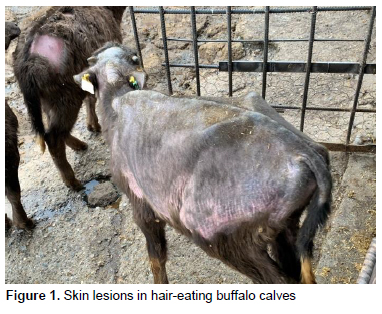
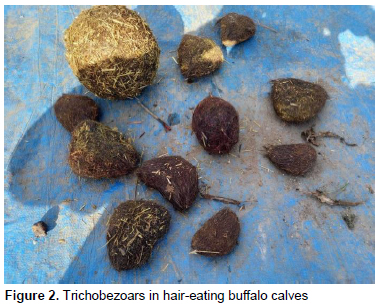
Animals with hair-eating symptoms ate each other’s hair and showed growth retardation, cachexia, alopecia and skin lesions during a clinical examination (Figure 1). Constipation and trichobezoars were observed in some of the animals along with the above manifestations (Figure 2).
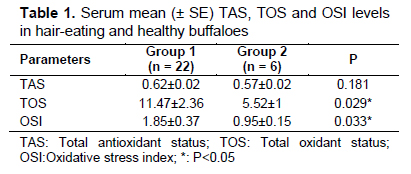
No statistically significant difference was found between the serum mean TAS values of the calves included in Group 1 and Group 2 (P>0.05), whereas there was a significant difference between serum mean TOS and OSI values (P<0.05, Table 1).
Tartışma
Pica is observed in a wide range of animals with multiple forms and it is defined as the abnormal appetite or consumption of substances that do not have any nutritional value [17]. Animals with pica may show appetite for non-feedstuff substances such as soil, bones and hair in addition to licking surfaces [18].This behaviourin buffaloes may lead to decreased milk yield, growth retardation, infertility and death caused by foreign body syndrome, thereby resulting in heavy economic losses [4]. Hair-eating disorder, a form of allotriophagia [19], is associated with weight loss, growth retardation, parakeratosis and alopecia in animals [19,20]. In addition, it may induce clinical symptoms such as blockages in the digestive tract, digestive disorders, pain and abdominal bloating [1,7] as a result of the accumulation of swallowed hair casts in the gastrointestinal tract and the transformation into undigested masses called trichobezoars [21]. In the present study, symptoms of growth retardation, dry skin and hair and alopecia were recorded in buffalo calves that ate each other’s hair. Furthermore, constipation and trichobezoars were detected in some of the calves.
Pica is an important condition in the ruminants that induces the oxidation process by causing stress [13]. It was reported that the amount of free radicals increased in certain cases, including stress, chronic diseases, infection and digestive disorders [11]. These free radicals were involved in the formation of inflammation and keratinization abnormalities in the skin [15] and the occurrence of tissue damage [11].
The body fights against the excess free radicals via its antioxidant defence system, which comprises antioxidant enzymes and nutritional antioxidants [22]. The antioxidant system prevents the damage caused by free radicals [10]. Antioxidants reduce the level of free radicals, thereby preventing them from damaging the cell [23].
Studies have shown that road transport [24], toxoplasmosis [9], lactation, and pregnancy [25], which cause stress in animals, lead to changes in oxidative stress parameters. In addition, it was reported that TOS level increased in tongue-playing cattle, but no change in TAS level [26].
Relevant studies investigating oxidative stress in animals with pica symptoms reported high levels of malondialdehyde [13,17], a marker of oxidative stress and low levels of total antioxidant capacity [13].
In the present study, serum mean TAS levels showed no significant differences between Group 1 and Group 2 (P>0.05). Group 1 had significantly higher serum mean TOS and OSI levels than Group 2 (P<0.05). These results suggested that the oxidant/antioxidant balance was altered in the buffalo calves with symptoms of hair-eating.
In conclusion, the oxidative/antioxidative balance in the buffalo calves with hair-eating symptoms shifted in the direction of oxidation; thus, the administration of drugs with antioxidant effects might prove beneficial in the treatment of these animals.
Acknowledgement
The authors would like to thank Prof. Dr. Hasan İÇEN for his kind assistance when performing this study.
References
- Agaoglu ZT, Akgul Y. Metabolic Diseases. In: Gul Y. (Editor). Internal Diseases of Ruminant Animals (Cattle, sheep and goats), 3rd Edition. Malatya: Medipress 2012; 491-492.
- Firyal S. Pica (depraved appetite; allotrophagia) in domestic animals and man. Pak Vet J 2007; 27: 208-210.
- Aytekin I, Onmaz AC, Unubol Aypak S, Gunes V, Kucuk O. Changes in serum mineral concentrations, biochemical and hematological parameters in horses with pica. Biol Trace Elem Res 2011; 139: 301-307.
- Lengare AS, Bhikane AU, Ghoke SS, Awaz KB. Pica in Buffaloes with special reference to its etiology and treatment. Intas Polivet 2012; 13: 62-66.
- Nevill CH, Lutz CK. The effect of a feeding schedule change and the provision of forage material on hair eating in a group of captive baboons (Papio hamadryas sp.). J Appl Anim Welf Sci 2015; 18: 319-331.
- Baydar E, Ozcelik M, Gazioglu A. Some trace elements and serum biochemistry in sheep with fleece eating. Firat University Journal of Health Sciences (Veterinary) 2015; 29: 187-190.
- Huang CY, Takeda KI. The wool-biting behaviour of sheep: A short review. Animal Behaviour and Managament 2015; 51: 65-72.
- Tabakoglu E, Durgut R. Oxidative stress in veterinary medicine and effects in some important diseases. The Journal of Adana Veterinary Control and Research Institute 2013; 3: 69-75.
- Bozukluhan K, Merhan O, Kiziltepe S, Harmankaya A, Gokce G. Determination of oxidative stress and ceruloplasmin levels in sheep with toxoplasmosis. Van Vet J 2020; 31: 83-86.
- Merhan O, Tasci GT, Bozukluhan K, Aydin N. Determination of oxidative stress index and total sialic acid in cattle infested with Hypoderma spp.. Kafkas Univ Vet Fak Derg 2020; 26: 633-636.
- Bozukluhan K, Merhan O, Ogun M, Cihan M, Gokce G. Determination of the levels of some oxidative stress parameters in calves with omphalitis. Firat University Journal of Health Sciences (Veterinary) 2016; 30: 79-81.
- Dimri U, Sharma MC, Swarup D, Ranjan R, Kataria M. Alterations in hepatic lipid peroxides and antioxidant profile in Indian water buffaloes suffering from sarcoptic mange. Res Vet Sci 2008; 85: 101-105.
- Elshahawy II, Aly MA. Some studies on deviated appetite (pica) in cattle. Alex J Vet Sci 2016; 51: 97-10.
- Aydogdu U, Coskun A, Basbug O, Agaoglu ZT. Evaluation of total antioxidant status and oxidative stress index in dogs with parvoviral enteritis. Firat University Journal of Health Sciences (Veterinary) 2018; 32: 161-164.
- Camkertan I, Sahin T, Borazan G, et al. Evaluation of blood oxidant/antioxidant balance in dogs with sarcoptic mange. Vet Parasitol 2009; 161: 106-109.
- Arslan S, Yenilmez K, Oncel T. Serum levels of minerals in dogs with Leishmania infantum. Firat University Journal of Health Sciences (Veterinary) 2021; 35: 136-138.
- Li Z, Liao Q, Han Y, Deng L, Liu H. A study of serum mineral, antioxidant capacity, and hematobiochemical parameters in horses with pica in China. J Vet Behav 2020; 37: 81-85.
- Salem NY. Clinical and laboratory investigations associated with sheeps’s allotrophagia. Vet Med J Giz 2017; 63: 1-6.
- Icen H, Sekin S, Simsek A, Duz Z. Research on haematological and biochemical parameters in lambs eating each other’s wool and on treatment. Firat University Journal of Health Sciences (Veterinary) 2008; 22: 159-162.
- Ebrahim ZK. Clinical, haematological and biochemical studies on wool eating sydrome in sheep. Alex J Vet Sci 2015; 46: 95-99.
- Mejido DCP, Dick JR EJ, Williams PC, et al. Trichobezoars in baboons. J Med Primatol 2009; 38: 302-309.
- Amer RA, El-Attar HEMA, Hefnawy A, Helal MAY. The relationship between deficiency of some trace elements, oxidative stress, immunoglobulin E and vitamin A in sheep affected with skin diseases. Benha Vet Med J 2020; 38: 10-16.
- Ertas F, Kirmizigul AH. Investigation of oxidative stress and metabolic profile in sheep with fascioliasis. Atatürk University J Vet Sci 2021; 16: 204-210.
- Cetin E, Cetin N, Kucuk O. The effect of road transport on oxidant-antioxidant system in yearling lambs. Atatürk University J Vet Sci 2011; 6: 103-109.
- Avci C, Kizil O. The effects of mineral solution on stress parameters in the transition cows. Firat University Journal of Health Sciences (Veterinary) 2012; 26: 87-91.
- Kirmizigul AH, Ozcelik M, Ogun M, et al. Serum Cu, Mn and Zn levels and oxidative stress in cattle performing tongue-playing. Kafkas Univ Vet Fak Derg 2019; 25: 787-791.
- The Effect of Intramuscular Vitamin C Administrations on Semen Quality in Rams
- KOÇLARDA SPERMA KALİTESİ ÜZERİNE KASİÇİ VİTAMİN C UYGULAMALARININ ETKİSİ
- Seroepidemiology of Parainfluenzavirus Type-3 Infection of Sheep in Diyarbakır and Şanlıurfa and Their Vicinity.
- DİYARBAKIR VE ŞANLIURFA YÖRESİNDE YETİŞTİRİLEN KOYUNLARDA PARAİNFLUENZAVİRUS TİP-3 ENFEKSİYONUNUN SEROEPİDEMİYOLOJİSİ
- Seroepidemiology of Parainfluenzavirus Type-3 Infection of Goats in Diyarbakır and Şanlıurfa and Their Vicinity