
Doksorubisin Uygulanan Ratlarda COQ10 ve Vitamin E’nin Kanda Lipit Peroksidasyonu, Bazı Antioksidan ve Biyokimyasal Parametrelere Etkisi
Cilt 35, Sayı 2
Mart 2021 · Sayfalar 103-108
Doksorubisin Uygulanan Ratlarda COQ10 ve Vitamin E’nin Kanda Lipit Peroksidasyonu, Bazı Antioksidan ve Biyokimyasal Parametrelere Etkisi
Effects of CoQ10 and Vitamin E on Blood Lipid Peroxidation, Some Antioxidant and Biochemical Parameters in Doxorubicin Administered Rats
Semih YAŞAR1, Fatmagül YUR2, Ebubekir CEYLAN3
2Mugla Sitki Kocman University, Faculty of Health Sciences, Department of Nutrition and Dietetics, Muğla, TURKEY
3Ankara University, Faculty of Veterinary Medicine, Department of Internal Diseases, Ankara, TURKEY
Bu çalışmada doksorubisin uygulanan ratlarda, Koenzim Q10 (CoQ10) ve vitamin E’in lipit peroksidasyonu, antioksidan profil ve bazı biyokimyasal parametreler üzerine etkisi araştırıldı. Çalışmada altı aylık 40 adet Wistar-Albino ırkı erkek rat kullanıldı. Hayvanlar dört gruba ayrıldı. Birinci grup ratlara doksorubisin 2.5 mg/kg/serum fizyolojik i.p. olarak haftada bir kez 6 hafta süreyle uygulandı. İkinci grup ratlara doksorubisine ilave olarak CoQ10 4 mg/kg/canlı ağırlık oranında i.p. olarak hergün uygulandı. Üçüncü grup ratlara sadece CoQ10 4 mg/kg/canlı ağırlık oranında yine günlük olarak verildi. Dördüncü grup ratlara doksorubisine ilave olarak vitamin E 10 mg/kg/subkutan/haftada iki kez 6 hafta süreyle uygulandı. Çalışma süresi altı hafta olarak planlandı. Çalışmaya başlamadan önce ratlardan alınan kanlar kontrol grubu oluşturmak amacıyla kullanıldı. Altıncı hafta sonunda tüm ratlardan kan örnekleri alındı. Analizler sonucunda tüm gruplarda malondialdehit ve seruloplazmin düzeylerinde önemli artışlar gözlendi. Tüm gruplarda glutatyon düzeylerinde kontrol grubuna göre düşüşler gözlendi. Retinol ve α-tocopherol düzeylerinde farklılık gözlenmedi. Albumin düzeylerinde önemli azalmalar ve globülin düzeylerinde önemli artışlar belirlendi. Total protein düzeylerinde önemli artışlar, alanin aminotransferaz düzeylerinde DXR grubunda önemli bir artış diğer guruplarda düşüşler gözlendi. Glukoz düzeylerinde ise belirgin düşüşler görüldü. Çalışmada DXR’nin oksidatif etkisi belirgin bir şekilde görüldü ancak verilen CoQ10 ve vitamin E’nin antioksidan etkileri istenilen düzeyde belirgin olarak gözlenemedi. Çalışma verilerine göre CoQ10 ve vitamin E gibi antioksidan maddelerin, çeşitli ilaçların neden olduğu stres ve hasarı azaltmak için kullanılabileceği ancak verilen ilaçların kullanım süresinin antioksidan maddelerin başarısını azaltabileceği sonucuna varıldı.
This study was aimed to investigate the effects of vitamin E and Coenzyme Q10 (CoQ10) on lipid peroxidation, antioxidant profile and some biochemical parameters in the doxorubicin administered rats. 40 Wistar-Albino breed male, 6 months old rats were used. The animals were divided into four equal groups. The first group received doxorubicin (hydroxy daunorubicin) (2.5 mg/kg/week/i.p.). The second group was given CoQ10 (4 mg/kg/daily/i.p.) in addition to doxorubicin. The third group received only CoQ10 (4 mg/kg/daily/i.p.). The fourth group was dministered with vitamin E (10 mg (15 IU) /kg/subcutaneous/two times a week), in addition to doxorubicin. The study period was six weeks. The blood samples taken from the rats before the beginning of the experiment was used as the control group. At the end of the 6th- week, the blood samples were taken from all rats. As a result of the analysis, significant increases were observed in malondialdehyde and ceruloplasmin levels in all groups. Glutathione levels were decreased in all groups compared to the control group. No difference was observed in retinol and α-tocopherol levels. Significant decreases in albumin levels and significant increases in globulin levels were determined. Significant increases in total protein levels, significant increases in alanine aminotranferase levels in the DXR group, and decreases in other groups were observed. Significant decreases were observed in glucose levels. In the study, the oxidative effect of DXR was clearly seen, but the antioxidant effects of CoQ10 and vitamin E were not observed at the desired level. According to the data of our study, it was concluded that antioxidant substances such as CoQ10 and vitamin E can be used to reduce stress and damage caused by various drugs, but the duration of use of the given drugs may reduce the success of antioxidant substances.
Giriş
Doxorubicin (Adriamycin, DXR), is an anthracycline derived from Streptomyces peucetius variete caesius cultures. Besides the superiority of its relatively wide spectrum and powerful effect, it also has a disadvantage of strong toxicity, as doxorubicin has an irreversible cardiotoxic effect. DXR is an inhibitor of the DNA topoisomerase II enzyme and damages DNA. In addition, reactive oxygen species have an important role in DXR-induced cardiotoxicity. Besides, it plays an important role in many other mechanisms such as mitochondrial dysfunction, a disruption in iron regulatory protein, nitric oxide release,inflammatory mediators, calcium dysregulation, autophagy and cell death. It has been shown that mitochondria are constantly damaged by DXR, resulting in multiple structural and functional disorders [1].CoQ10 is a crucial element of the human electron transport chain (ETC) located in the mitochondria. In addition, it is an important fat-soluble antioxidant tasked with protecting lipoproteins and cell membranes against oxidative damage. CoQ10 (ubiquinone in its oxidized form) is reduced by multiple oxidoreductases to maintain a redox cycle. In its reduced form, CoQ10 H2 (ubiquinol) can transfer electrons to acceptors such as complex III in mitochondrial ETC or, for example, to α-tocopherol in other cellular membranes [2].
Vitamin E was discovered by Evans and Bishop in 1922 as a vital dietary biomolecule for mammalian reproduction. However, its precise biological role remains controversial to date. Vitamin E refers to two families of molecules known as tocopherols and tocotrienols, each consisting of four members (α, β, γ and δ) that differ in the methylation of the chromanol rings. Given this somewhat minor structural difference between family members and the fact that all species are regularly consumed in the average diet, it is noteworthy that α-tocopherol is only one of eight variants actively maintained by the human body. Vitamin E is widely used as a biocompatible preservative in the cosmetic and food industries. Many studies argue that vitamin E is the first line of defense against oxidation in cell membranes [3].
The aim of the present study was to determine the effects of CoQ10 and vitamin E on lipid peroxidation and antioxidant profile in rats treated with the chemotherapeutic agent doxorubicin, along with the biochemical parameters of albumin, globulin, total protein, alanine aminotransferase (ALT) and glucose levels.
Gereç ve Yöntem
Research and Publication Ethics: This study was deemed ethically appropriate by the Van Yuzuncu Yil University Scientific Ethics Committee and Animal Research Ethics Board in their assessment meeting on 28-02-2007 (Code: 03-Decision 1).The study material o consisted of 40 Wistar–albino male rats of six months of age. Blood samples were collected from ten randomly selected rats to create the control data. The rats were then divided into 4 groups with 10 animals per group.
These four groups are as follows:
1. Group: (DXR); the rats in this group were intraperitoneally treated with 2.5 mg/kg doxorubicin in physiological saline solution once a week, for 6 weeks [4].
2. Group: (DXR+CoQ10); the rats in this group were also intraperitoneally treated with 2.5 mg/kg/doxorubicin in physiological saline solution once a week for 6 weeks. In addition, they were given CoQ10 intraperitoneally for 6 weeks at the dose of 4 mg/kg/live weight [5].
3. Group (CoQ10); the rats in this group were administered intraperitoneally with CoQ10 alone every day for 6 weeks, at the dose of 4 mg/kg/live weight.
4. Group: (DXR+Vit E); the rats in this group were intraperitoneally administered with doxorubicin 2.5 mg/kg in physiological saline solution once per week, for 6 weeks, like the first and second groups. They were also treated with Vitamin E subcutaneously at the dose of 10 mg/kg (15 IU), twice per week for 6 weeks [6].
The study was continued for 6 weeks. At the end of the 6th week blood samples were taken from all rats according to ethical rules.
In the study, whole blood samples taken from EDTA tubes was used for the measurement of malondialdehyde (MDA) and glutathione (GSH) levels. For vitamin A and vitamin A levels, plasmas samples obtained as a result of centrifugation of blood taken in EDTA tubes were used. For all the remaining parameters, serum samples obtained from blood collected in gel tubes were used.
GSH levels of the samples were determined using the color reaction method between the filtrate of the fully-precipitated ethylenediaminetetraacetic acid (EDTA) blood and Ellman's reagent (DTNB) [7,8]. The MDA levels were determined through thiobarbituric acid (TBA) reactivity method [9,10]. The ceruloplasmin levels were determined using the Ravin method [11]. Plasma vitamin A and vitamin E levels were measured using the extraction method specified by Miller and Yang [12].
Albumin, glucose, globulin, total protein, and alanine aminotransferase (ALT) analyses were performed using commercial kits on Abaxis VetScan Autoanalyzer [13].
SPSS (version 18) was used for statistical analysis of the data. Kruskalwallis, one of the nonparametric analysis methods, was used for the differences between the groups. OneWay ANOVA (Tukey HSD) was then used to determine from which group the difference originated. Means with a P value of 0.05 or less were considered significant relative to each other [14].
Bulgular
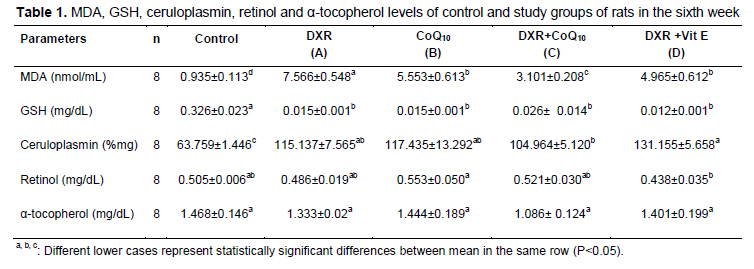
As a result of the analysis, it was seen that MDA levels increased statistically significantly in all groups compared to the control group. However, the highest value was seen in group A (P<0.001). Compared to the increase in group A, the highest decrease was observed in group C. Statistically significant decreases were observed in GSH levels in all groups versus the control group (P<0.001).Statistically significant increases were observed in ceruloplasmin levels in all groups compared to the control group (P<0.001).
Retinol levels decreased in groups A and D compared to the control group; It increased in groups B and C. α-tocopherol levels were decreased in all groups compared to the control group.
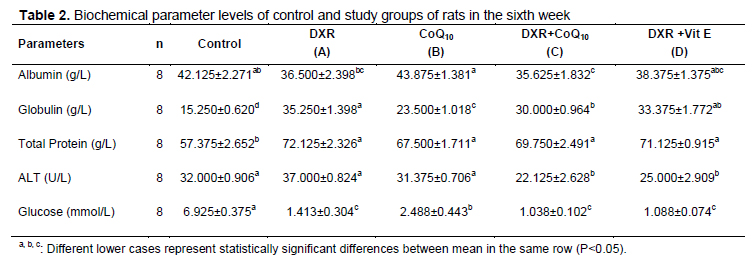
Compared to the control group, albumin levels decreased in groups A, C (P<0.05) and D, but increased in group B. Globulin levels were statistically significantly increased in all groups compared to the control group (P<0.001). Total protein levels showed statistically significant increases in groups A (P<0.001), B (P<0.05), C (P<0.05) and D (P<0.001) compared to the control group.
ALT levels increased in group A (P<0.001) compared to the control group; It decreased in B, C (P<0.05) and D (P<0.05) groups.
Glucose levels were statistically significantly decreased in all groups compared to the control group (P<0.001).
MDA, GSH, ceruloplasmin, Retinol and α-tocopherol results are given in Table 1, Albumin, Globulin, Total Protein, ALT and glucose results are given in Table 2.
Tartışma
DXR is an anthracene-derived drug. Antioxidants have been shown to have a protective effect against oxidative damage induced by antineoplastics, like doxorubicin [13,15]. CoQ10 is an endogenous lipophilic antioxidant, and is a key component for mitochondrial electron transport. CoQ10 is used to treat oxidative damages and disorders that occur due to suboptimal metabolism of cellular energy [2]. Vitamin E forms the first line of defense to protect the unsaturated fatty acids in the cell membrane against oxidation with free radicals [16].In various studies conducted on this subject, MDA levels have been reported to increase in DXR-treated rats [17-20]. In a study conducted on the heart tissues of rats, the researchers reported that the levels of MDA in the tissues of rats treated with DXR were higher than all other groups' and that the effects of CoQ10 and L-carnitine reduced the effects DXR [21]. In a study conducted on rabbits, it was found that DXR treatment caused statistically significant increases in MDA levels, an end product of lipid peroxidation. The mean MDA values displayed significant increases at days 3, 4, 5 and 6 in the group treated with DXR+L-carnitine, compared to pre-treatment levels and the levels obtained at the 1st and 2nd day of the treatment. In the group treated only with L-carnitine, on the other hand, significant decreases were observed in mean MDA levels, compared to the pre-treatment period [22]. In many studies, researchers reported that CoQ10 had protective effects against the toxic effects of doxorubicin [23-25] and CoQ10 has been shown to have protective properties against toxic effects of doxorubicin in testicular [26], kidney [27] and heart tissues [28,29].
Antineoplastic agents used in cancer patients undergoing chemotherapy cause oxidative stress [30]. Doxorubicin was used to create cytotoxicity in lung tumor cells, and it has been reported by researchers that CoQ10 alone was not enough to reduce the effects of doxorubicin [24]. The oxidative stress is manifested as increased lipid peroxidation products, and reduction of compounds with antioxidant properties in plasma such as Vitamins E and C and β-carotene, and glutathione.
Similar to the previous reports, serum MDA levels significantly increased in the groups treated with doxorubicin when compared to the control group in our study. Serum MDA levels of the DXR+CoQ10 and DXR+Vitamin E groups were lower compared to the DXR group but it was the lowest in the DXR+CoQ10 group.
Reduced GSH, a cytoplasmic antioxidant, plays an important role in cellular defense mechanisms against damage induced by lipid peroxidation. Mitochondrial GSH plays a critical role in cellular life and regulation of conditions caused by sulphydryl groups and resulting in decreased permeability in mitochondrial membranes [3].
Karapehlivan et al. [22] have found out that GSH levels of rabbits treated with DXR decreased significantly beginning from the third day of the treatment compared to the starting point, no significant change occurred in the group treated with DXR+L-carnitine, and that it increased significantly from the second day of the treatment in the group treated with L-carnitine alone. In another study, it was reported that GSH values in DXR group decreased compared to control [20].
In our study, GSH levels in all experimental groups were found to be below that of the control group. GSH value in DXR + CoQ10 group was found to be higher than DXR group.
In a study conducted at the cellular level, it was reported that CoQ10 and lutein had a protective effect against the oxidative damage of DXR and Etoposide as a result of SOD, GPx, ROS, and LPO tests [31].
Ceruloplasmin, mainly synthesized in the liver, is an acute phase protein that exhibits a moderate response in conditions such as inflammation and tissue damage [32].
Yu [33] reported that increase of ceruloplasmin take place depending on the lipid peroxidation in the cells. The results of the present study is in parallel with the study of Yu [33] as the ceruloplasmin levels were increased. In our study, ceruloplasmin levels were higher in all groups than that of the control group (P<0.001). However, ceruloplasmin levels were higher in DXR + vitamin E group than DXR group. The increase in the amount of ceruloplasmin in the vitamin E group might indicate that vitamin E has positive contributions to the prevention of lipid peroxidation.
Numerous studies report that Vitamins C, A, and E have antioxidant properties and reduce the peroxidation products or have supplementary effects for antineoplastic agents [3,34-36]. Shinozawa et al [37] observed a slight increase in the survival periods of rats treated with 100 mg/kg/day alpha-tocopherol acetate before the doxorubicin treatment, but in contrast, they also observed a significant decrease in their survival periods when treated with 500 mg/kg/day alpha-tocopherol acetate. Myers et al. [38] have observed that administration of tocopherol significantly reduced the doxorubicin-caused cardiomyopathies. Another study reports that increased doses of Vitamin E treatment could have protective effects against doxorubicin-induced cardiac toxicities [39]. In the present study, it was observed that retinol levels increased in CoQ10 groups when compared to DXR groups and α-tocopherol levels decreased in all DXR groups. However, these changes were not statistically significant.
Albumin is known to be a stronger anti-oxidant compared to globulin, due to its molecular structure [40] Albumin has the capability of scavengering hydroxyl radicals [41]. In a previous study, serum albumin levels were reported to be low in pemphigus vulgaris patients [42]. Oxidative stress and low antioxidant status in myasthenia gravis (MG) patients have been reported to also have significantly decreased in serum albumin levels [43]. In rats experimentally induced sepsis, the albumin treatment had a 25% antioxidant effect on free radicals [44]. In this study, albumin levels decreased in DXR, DXR+CoQ10 (P<0.05) and DXR +VitE groups. It increased in the CoQ10 group.
Afsar et al. [45], in their study, observed that the albumin level decreased in rats given DXR and that A. hydaspica polyphenol-rich ethyl acetate extract (AHE) given as a preservative increased the albumin level. Again, in this study, they reported that globulin levels decreased in rats given DXR and that AHE given as a preservative increased globulin levels.
In this study, the globulin levels increased significantly in all groups compared to the control group (P<0.001). In this study, total protein levels showed significant increases in DXR (P<0.001), CoQ10 (P<0.05), DXR+ CoQ10 (P<0.05) and DXR+VitE (P<0.001) groups.
Afsar et al. [45] reported in their study that the total protein level decreased in rats given DXR and increased in groups given AHE.
For all the experiment groups in the study, glucose levels were found to have decreased. Some studies report that oxidative stress can cause hyperglycemia [46,
In all experiment groups, MDA levels were found to have increased while GSH levels were significantly decreased. Elevations in ceruloplasmin levels were observed. In the study, especially glucose levels decreased in all groups. It was observed that CoQ10 alone slightly increased this value, but CoQ10 and vitamin E did not show any effect in the groups with DXR.
In similar studies, it has been seen that antioxidant effective substances are successful against the effects of DXR. In our study, however, CoQ10 and Vit E did not show a curative effect at the desired level. The probable reason for this is estimated to be the length of the working time. The length of the period increased the stress factor and caused the expected improvements not to be seen. However, this study also reveals that prolonging the use of oxidant agents such as DXR will reduce the curative effects of antioxidant agents.
In conclusion, the results obtained in this study may suggest that various medication used in the treatment of cancer and some other diseases cause a variety of oxidative damages, and use of anti-oxidants could have favorable results in such cases.
Acknowledgments
The authors would like to thank Okan ARIHAN for his assistance in the writing process.
References
- Determination of Arterial Oxygen Saturation in Newborn Lambs by Pulse Oximetry
- Comparative Isolation of Serum ß + Pre- ß Lipoproteins of Human and Various Domestic Animal Species By Heparin/MnCl2 Precipitation Method
- The Effects of Levamisole on the Pregnancy Rate, Avarage Litter Size, Sexuality, Living Rate and Lactation Period in Rats
- RATLARDA LEVAMİZOL’ÜN GEBE KALMA ORANI, YAVRU SAYISI, CİNSİYETİ, YAŞAMA ORANI VE LAKTASYON SÜRESİNE ETKİSİ
- Separation of Human and Various Animal Lipoproteins by Vertical Agarose Gel Electrophoresis