
Geçiş Dönemindeki Düşük Vücut Kondisyon Skoruna Sahip Süt İneklerinde Oksidan/Antioksidan Durum ile Tiyol/Disülfid Homeostazının Değerlendirilmesi
Volume 40, Issue 3
October 2026 · Pages 261-265
Geçiş Dönemindeki Düşük Vücut Kondisyon Skoruna Sahip Süt İneklerinde Oksidan/Antioksidan Durum ile Tiyol/Disülfid Homeostazının Değerlendirilmesi
Evaluation of Oxidant/Antioxidant Status and Thiol/Disulfide Homeostasis in Dairy Cows with Low Body Condition Scores During the Transition Period
Sezai ARSLAN1, Kudret YENİLMEZ2
2Tekirdağ Namık Kemal University, Faculty of Veterinary Medicine, Department of Obstetrics and Gynecology Tekirdağ, TÜRKİYE
Bu çalışmada, geçiş döneminde düşük vücut kondisyon skoruna (BCS 2.0-2.5) sahip, klinik olarak sağlıklı multipar süt ineklerinde metabolik durum ve oksidatif stres göstergelerindeki değişimler değerlendirildi. Çalışmanın amacı; prepartum ve postpartum dönemde kalsiyum (Ca), esterleşmemiş yağ asitleri (NEFA), β-hidroksibütirik asit (BHBA), total antioksidan kapasite (TAS), total oksidan kapasite (TOS), oksidatif stres indeksi (OSI) ile thiol/disülfit homeostazı parametrelerini ölçerek, geçiş döneminde oksidatif stresin rolüne ve thiol/disülfit dengesinin önemine katkı sağlamaktı. Çalışmada materyal olarak 3-5 yaşlı Holştayn ırkı 20 adet inek kullanıldı. Bu hayvanlardan doğuma yaklaşık 7 gün kala (7±4 gün) ve doğumdan 7 gün sonra kan örneği alındı. Alınan örneklerden serumlar ayrıştırıldı ve analizler yapılıncaya kadar -80°C’de saklandı. Ca, NEFA ve BHBA düzeyleri otoanalizör ile; TAS, TOS, doğal thiol (NTHIOL) ve total thiol (TTHIOL) düzeyleri ise ticari test kitleri kullanılarak kolorimetrik-spektrofotometrik yöntemle ölçüldü. Bulgulara göre postpartum dönemde, prepartum döneme kıyasla NEFA ve TOS düzeylerinde anlamlı bir artış saptandı. Buna karşın postpartum dönemde Ca düzeyinde azalma; BHBA, TAS, OSI ile nativ/total thiol ve disülfit düzeylerinde artış eğilimi görülse de bu değişimler istatistiksel olarak anlamlı bulunmadı. Sonuç olarak bu çalışma, düşük kondisyonlu ve klinik olarak sağlıklı ineklerde geçiş döneminde enerji metabolizması açısından stresin oluşabileceğini ve oksidatif yükün artabileceğini göstermektedir. Bu nedenle geçiş döneminde metabolik ve oksidatif göstergelerin izlenmesi, olası risklerin erken fark edilmesi açısından faydalı olabilir.
In this study, changes in metabolic status and oxidative stress indicators were evaluated in clinically healthy multiparous dairy cows with low body condition scores (BCS 2.0–2.5) during the transition period. The aim of the study was to contribute to understanding the role of oxidative stress and the importance of the thiol/disulfide balance during the transition period by measuring calcium (Ca), non-esterified fatty acids (NEFA), β-hydroxybutyric acid (BHBA), total antioxidant status (TAS), total oxidant status (TOS), oxidative stress index (OSI), and thiol/disulfide homeostasis parameters in the prepartum and postpartum periods. A total of 20 Holstein cows aged 3–5 years were included in the study. Blood samples were collected from these animals approximately 7 days before parturition (7±4 days) and 7 days after parturition. Serum was separated from the collected samples and stored at -80°C until further analysis. Ca, NEFA, and BHBA levels were measured using an autoanalyzer, while TAS, TOS, native thiol (NTHIOL), and total thiol (TTHIOL) levels were determined using commercial assay kits with a colorimetric-spectrophotometric method. According to the findings, NEFA and TOS levels showed a significant increase in the postpartum period compared to the prepartum period. In contrast, although a decrease in Ca levels and an increasing tendency in BHBA, TAS, OSI, native/total thiol, and disulfide levels were observed postpartum, these changes were not statistically significant. In conclusion, this study indicates that even in clinically healthy cows with low body condition scores, metabolic stress related to energy metabolism may occur and oxidative load may increase during the transition period. Therefore, monitoring metabolic and oxidative indicators during the transition period may be beneficial for the early detection of potential risks.
Introduction
The transition period in dairy cows covers the 3 weeks prepartum and 3 weeks postpartum. This is a critical period during which metabolic diseases are frequently observed [1-3]. Metabolic diseases seen during the transition period in dairy cows include hypocalcemia, hypomagnesemia, and ketosis [2]. In cows during the transition period, the need for nutrients increases rapidly; consequently, negative energy balance (NEB) occurs, body fat is mobilized and NEFA are released into the blood, while ketone bodies such as BHBA increase in the liver [4,5]. Ospina et al. [5] reported that cows with high NEFA and BHBA levels during the transition period had decreased milk yield and impaired reproductive performance.Dairy cows adapt to metabolic and physiological changes during the transition period. The increase in metabolic requirements necessitates greater oxygen utilization. Increased oxygen consumption leads to the formation of more reactive oxygen species (ROS) [6]. Oxidative stress is defined as the occurrence of oxidative damage in cells as a result of excessive production of ROS or insufficient antioxidant defense [3,6].
In determining the level of oxidative stress, measurements such as malondialdehyde (MDA), Reactive Oxygen Metabolites (ROM), superoxide dismutase (SOD), glutathione peroxidase (GSH-Px), and total antioxidant capacity (TAC) are commonly used [7-9]. In recent years, dynamic thiol/disulfide balance has been introduced into the veterinary field as a new indicator of oxidative stress. Thiols constitute a large part of the total antioxidants in the body and contain sulfhydryl (-SH) groups [10]. Free radicals oxidize thiol groups and form disulfide bonds (-S-S-). Since this reaction is reversible, the thiol–disulfide transformation contributes to dynamic redox balance in the body [11]. Changes in the thiol/disulfide balance during the transition period have also begun to be investigated in cattle. In one study, it was reported that in Montafon breed cows, postpartum total thiol and disulfide levels increased compared to prepartum values and were statistically significant, whereas no statistical significance was detected in Simmental breed cows [12].
It has been stated that there is a relationship between BCS and the incidence of metabolic diseases [13,14]. In a study conducted on Holstein heifers with different body condition scores, it was reported that postpartum total thiol and disulfide levels increased significantly in heifers with low, medium, and high body condition scores [15]. These findings indicate that increased metabolic activity and the resulting oxidative load during the transition period affect thiol/disulfide homeostasis.
Studies on this topic in cows with low body condition scores are limited. In this study, Ca, NEFA, BHBA, TAS, TOS, OSI, NTHIOL, TTHIOL, and disulfide levels were determined in cows with low BCS (2–2.5) during the prepartum and postpartum periods. In line with the findings obtained, it was aimed to reveal the role of oxidative stress and the importance of thiol/disulfide homeostasis during the transition period and to contribute to a better understanding of the transition period physiology of cows with low body condition scores.
Material and Method
Research and Publication Ethics: This study was conducted in accordance with the principles of research and publication ethics and internationally accepted standards for animal welfare, and ethical approval was obtained from the Animal Experiments Local Ethics Committee of Tekirdağ Namık Kemal University (Approval No: T2025-2827).Animals: In the study, 20 multiparous Holstein dairy cows aged 3–5 years with a body condition score (BCS) of 2.0–2.5, located on a private commercial dairy farm in the Tekirdağ region, were used. BCS values were determined according to the scale defined by Wildman et al. [16]. The cows were clinically healthy, had no history of metabolic disease, and all experienced eutocous calving. Additionally, no clinical diseases or health complications occurred during the postpartum follow-up period. The average daily milk yield of the cows during the lactation period was 23.33±0.67 kg (range: 20–25 kg/day). During the study, the animals included in the study were fed ad libitum with a Total Mixed Ration (TMR; Dry matter 55%, crude protein 18%, crude cellulose 12%, crude fat 3.0%, crude ash 8%, starch 25%) that was offered twice daily specific to the transition period.
Biochemical Analyses: Blood samples were collected from each animal approximately 7 days before parturition (7 ± 4 days) in the prepartum period and 7 days after parturition in the postpartum period, before feeding, from the vena coccygea. The collected blood samples were allowed to clot and then centrifuged at 3000 rpm for 10 minutes to obtain serum. The obtained serum samples were stored at -80°C until analysis.
In serum samples, Ca, NEFA, and BHBA levels were measured using an automatic biochemical analyzer (Randox Imola, Antrim, England) with appropriate commercial kits. TAS, TOS, NTHIOL, and TTHIOL values were measured using commercial kits (Rel Assay Diagnostics, Mega Tıp, Turkey) using an Epoch microplate reader spectrophotometer (BioTek Instruments, VT, USA) according to the manufacturer’s instructions. The TAS and TOS assays were based on automated measurement methods previously described by Erel [17,18]. The OSI value was calculated by multiplying the ratio of the TOS value to the TAS value by 100. Thiol/disulfide homeostasis parameters (NTHIOL and TTHIOL) were measured based on the novel automated method developed by Erel and Neselioglu [11]. The disulfide level was calculated as half of the difference between TTHIOL and NTHIOL.
Statistical Analysis: A sensitivity power analysis was performed using G*Power version 3.1.9.7 (Heinrich-Heine University, Düsseldorf, Germany) to evaluate the adequacy of the sample size. Because prepartum and postpartum measurements were obtained from the same animals, the analysis was based on a paired-samples design using the "Means: Difference between two dependent means (matched pairs)" model. Assuming a two-tailed significance level of α=0.05, a statistical power (1−β) of 0.80, and a total sample size of 20 paired observations, the study was capable of detecting a minimum effect size of Cohen's dz=0.660. Data were expressed as mean±standard error (X̄±SEM) and median (Q1–Q3), and 95% confidence intervals (95% CI). The Shapiro–Wilk test was used to evaluate the normality of the data. The paired t-test was used for normally distributed data, and the differences between time points were evaluated with 95% CI. The Wilcoxon signed-rank test was used for non-normally distributed
Wilcoxon results are reported as Hodges–Lehmann (HL) estimate (95% CI). Statistical significance was considered at p<0.05.
numerical decline can be explained by the rapid increase in calcium secretion into the mammary gland with the onset of colostrum and milk production, which challenges calcium homeostasis during the periparturient period [20,21].
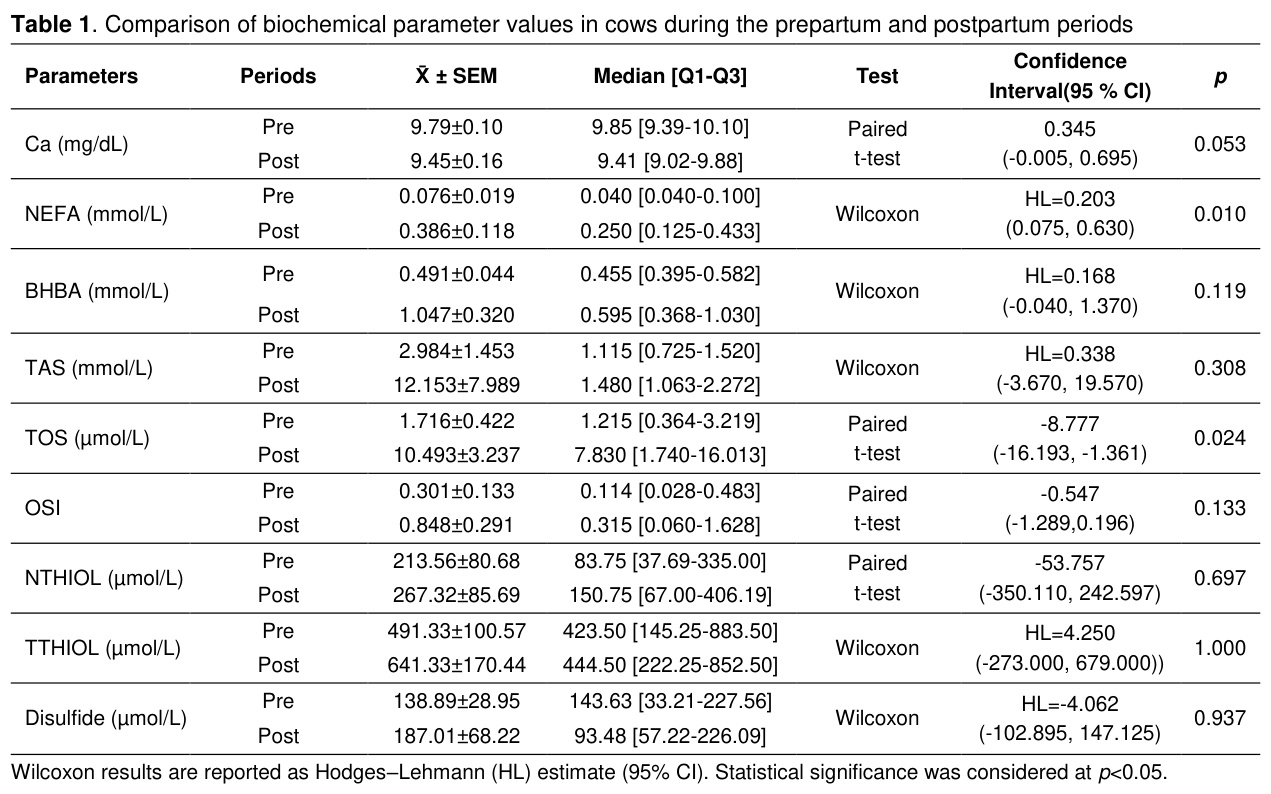
The increase in TOS in the postpartum period compared to prepartum indicates that the oxidative load rises markedly during the transition period. This finding supports the literature reporting increased oxidative stress during the transition period [6,22]. The periparturient period is a time of intense metabolic stress for cows. During lactation, energy requirements increase substantially, leading to greater oxygen use by tissues. Increased oxygen utilization results in more ROS production. A balance exists between ROS production data, and the direction and magnitude of the changes were estimated using the Related-Samples Hodges-Lehmann median difference with 95% CI. Statistical analyses were performed using SPSS 27.0 (IBM, USA) software. A p value <0.05 was considered statistically significant.
Results
In the comparison of prepartum and postpartum periods, NEFA and TOS levels increased significantly in the postpartum period (p<0.05; Table 1). No statistically significant differences were detected in the other parameters (Ca, BHBA, TAS, OSI, NTHIOL, TTHIOL, and disulfide) (Table 1).Discussion
In this study, metabolic and oxidative stress parameters of cows with low body condition scores during the transition period were investigated. Significant changes in energy metabolism were observed in cows during the postpartum period. The significant increase in NEFA levels reflects NEB. Following parturition, the sudden rise in energy requirements and reduced appetite cause cows to mobilize body fat reserves, resulting in a rapid increase in plasma NEFA concentration [4,19]. The elevation of NEFA in the postpartum period in our study indicates that substantial fat mobilization occurs even in cows with low body condition scores. Bernabucci et al. [8] reported that in cows with low, medium, and high body condition scores, only cows with high body condition scores showed a significant increase in NEFA pre- and postpartum. Structurally, our study resembles the NEFA increase reported by Bernabucci et al. [8] in high body condition score cows. Excessive NEFA elevation indicates increased mobilization from adipose tissue and higher NEFA flux to the liver. During the transition period, this situation increases the risk of ketosis / hyperketonemia [1,4,5]. Indeed, in our study, although BHBA levels were not statistically significant, they tended to increase postpartum, suggesting that cows with low BCS may be prone to ketosis.In our study, although Ca levels showed a numerical tendency to decrease in the postpartum period compared to the prepartum period, this change was not statistically significant (p=0.053). This slight and the antioxidant defense system. However, factors such as parturition stress, NEFA elevation (indicative of NEB), infections, and heat stress disrupt this balance, leading to oxidative stress [23]. In our cows, despite the absence of overt clinical disease, elevated oxidant levels indicate that the transition period can impose a significant oxidative load. The postpartum increase in OSI observed in this study also supports this notion. Although OSI increased postpartum compared to prepartum in our study, the change was not statistically significant due to variability. Nevertheless, the increase in mean OSI suggests a shift in oxidative balance toward pro-oxidants. Abuelo et al. [22] reported that OSI increases during the transition period reflect a disruption in the pro-oxidant/antioxidant balance and serve as an important parameter for detecting oxidative stress.
When examining TAS in our study, a higher mean TAS value was observed postpartum compared to prepartum; however, due to high individual variability, this increase was not statistically significant. Balkan et al. [12] reported that TAS was lower after calving compared to the prepartum period in both Montafon and Simmental breeds, while OSI was higher. Differences between our results and those reported by Balkan et al. [12] may largely arise from methodological differences in sampling timing. Balkan et al. collected prepartum samples between days 233–280 of gestation and postpartum samples 30 days after parturition, whereas our study collected samples approximately 7 days before parturition (7±4 days) and 7 days postpartum. Therefore, the different results between the two studies are likely due to time-dependent physiological fluctuations during the transition period and differences in sampling approaches.
Evaluation of thiol–disulfide balance in our study showed that NTHIOL, TTHIOL, and disulfide levels increased postpartum compared to prepartum; however, these increases were not statistically significant. Kayar et al. [15] reported that postpartum TTHIOL and disulfide levels significantly increased in low, medium, and high-condition heifers compared to prepartum, whereas no statistically significant change was observed in NTHIOL; increases were seen in low-condition heifers, while decreases tended to occur in medium and high-condition heifers. Similarly, Balkan et al. [12] reported that TTHIOL and disulfide levels significantly increased postpartum in Montafon cows but not in Simmental cows, and NTHIOL showed a non-significant increase in Montafon cows and a non-significant decrease in Simmental cows. Taken together, these findings indicate a general trend toward increased thiol–disulfide metabolism postpartum, though the statistical significance may vary depending on the cow’s condition, breed characteristics, and methodological differences in sampling timing.
An important point for the low-BCS cows in our study is the potential effect of body condition on metabolic and oxidative parameters. Many studies indicate that high-condition cows experience more severe negative energy balance and greater oxidative stress postpartum [8,24,25]. However, cows with a lower BCS also face risks during the transition period, such as lower milk yield, reduced reproductive performance, and a higher susceptibility to infections [24]. Low body condition may limit oxidative load by reducing fat accumulation and inflammation in the liver and other organs. Indeed, Roche et al. [24] emphasized that cows with ideal BCS show the best outcomes in terms of both health and production. While high-BCS cows lose more BCS postpartum, medium-BCS cows have better milk yield and fewer health problems [24]. In contrast, our study suggests that low BCS may help maintain oxidative stress at a manageable level, although it does not completely eliminate it. Nevertheless, low-BCS cows still need to quickly compensate for postpartum energy deficits and receive proper nutritional support to strengthen their antioxidant status.
This study has several limitations. First, the relatively small sample size and the inclusion of animals from a single farm may limit the generalizability of the findings to other herds and management conditions. In addition, although numerical changes were observed in some parameters, statistical significance was not achieved. Therefore, future studies including larger sample sizes and multiple farms are needed to further validate these findings.
Conclusion
In conclusion, cows with low body condition scores undergo significant metabolic and oxidative changes during the transition period. In this study, NEFA levels increased significantly postpartum, reflecting an energy deficit. Elevated NEFA and BHBA levels indicate that low-condition cows may experience subclinical energy metabolism disturbances during the transition period. The postpartum increase in TOS reveals an increased oxidative load associated with the transition period. These findings emphasize the role of oxidative stress in low-condition cows during the transition period and highlight the importance of monitoring these parameters in dairy herds.References
- Drackley JK. Biology of dairy cows during the transition period: The final frontier? J Dairy Sci 1999; 82 (11): 2259-2273.
- Mulligan FJ, Doherty ML. Production diseases of the transition cow. Vet J 2008; 176(1): 3-9.
- Abuelo A, Hernández J, Benedito JL, et al. The importance of the oxidative status of dairy cattle in the periparturient period: Revisiting antioxidant supplementation. J Anim Physiol Anim Nutr 2015; 99(6): 1003-1016.
- Adewuyi AA, Gruys E, Van Eerdenburg FJ. Non esterified fatty acids (NEFA) in dairy cattle. A review. Vet Q 2005; 27(3): 117-126.
- Ospina PA, Nydam DV, Stokol T, et al. Associations of elevated nonesterified fatty acids and beta-hydroxybutyrate concentrations with early lactation reproductive performance and milk production in transition dairy cattle in the northeastern United States. J Dairy Sci 2010; 93(4): 1596-1603.
- Sordillo LM, Aitken SL. Impact of oxidative stress on the health and immune function of dairy cattle. Vet Immunol Immunopathol 2009; 128(1-3): 104-109.
- Castillo C, Hernández J, Bravo A, et al. Oxidative status during late pregnancy and early lactation in dairy cows. Vet J 2005; 169(2): 286-292.
- Bernabucci U, Ronchi B, Lacetera N, et al. Influence of body condition score on relationships between metabolic status and oxidative stress in periparturient dairy cows. J Dairy Sci 2005; 88(6): 2017-2026.
- Zhang MQ, Heirbaut S, Hertogs K, et al. Periparturient oxidative and inflammatory status and their relation to energy metabolism and performance in transition dairy cows. J Dairy Sci 2025; 108(12): 13872-13889.
- Chianeh YR, Prabhu K. Protein Thiols as an Indicator of Oxidative Stress. Arch Med Rev J 2014; 23(3): 443-456.
- Erel O, Neselioglu S. A novel and automated assay for thiol/disulphide homeostasis. Clin Biochem 2014; 47(18): 326-332.
- Balkan BM, Meral O, Cetintav B, et al. Evaluation of thiol/disulphide and oxidant-antioxidant status of dairy cows in periparturient and post-partum period. Vet Med Sci 2024; 10(6): e70023.
- Gearhart MA, Curtis CR, Erb HN, et al. Relationship of changes in condition score to cow health in Holstein. J Dairy Sci 1990; 73(11): 3132-3140.
- Studer E. A veterinary perspective of on-farm evaluation of nutrition and reproduction. J Dairy Sci 1998; 81(3): 872-876.
- Kayar T, Ozkurt G, Erzurum O, et al. Thiol/Disulphide homeostasis in the relationship between body condition score and oxidative stress in periparturient period Holstein heifers. Vet Med Sci 2025; 11(3): e70326.
- Wildman EE, Jones GM, Wagner PE, et al. A dairy cow body condition scoring system and its relationship to selected production characteristics. J Dairy Sci 1982; 65(3): 495-501.
- Erel O. A novel automated method to measure total antioxidant response against potent free radical reactions. Clin Biochem 2004; 37(2): 112–119.
- Erel O. A new automated colorimetric method for measuring total oxidant status. Clin Biochem 2005; 38(12): 1103-1111.
- Wankhade PR, Manimaran A, Kumaresan A, et al. Metabolic and immunological changes in transition dairy cows: A review. Vet World 2017; 10(11): 1367-1377.
- Goff JP. Major advances in our understanding of nutritional influences on bovine health. J Dairy Sci 2006; 89(4): 1292-1301.
- Goff JP. The monitoring, prevention, and treatment of milk fever and subclinical hypocalcemia in dairy cows. Vet J 2008; 176(1): 50-57.
- Abuelo A, Hernández J, Benedito JL, et al. Oxidative stress index (OSI) as a new tool to assess redox status in dairy cattle during the transition period. Animal 2013; 7(8): 1374-1378.
- Sordillo LM. Selenium-dependent regulation of oxidative stress and immunity in periparturient dairy cattle. Vet Med Int 2013; 2013: 154045.
- Roche JR, Friggens NC, Kay JK, et al. Invited review: Body condition score and its association with dairy cow productivity, health, and welfare. J Dairy Sci 2009; 92(12): 5769-5801.
- Contreras GA, Sordillo LM. Lipid mobilization and inflammatory responses during the transition period of dairy cows. Comp Immunol Microbiol Infect Dis 2011; 34(3): 281-289.
- RATLARDA BAZI NİTROSOAMİNLERİN DÜŞÜK MİKTARDA-UZUN SÜRELİ VERİLMESİNİN KAN, KARACİĞER VE BÖBREKLERDE OKSİDATİF STRES ÜZERİNE ETKİLERİ
- Geçiş Dönemindeki İneklerde Stres Parametreleri Üzerine Mineral Uygulamasının Etkileri
- Yumurtlama Öncesi Dönemde Aydınlatma Programında Yapılan Değişikliğin Etlik Piliç Ebeveynlerinde Bazı Stres Parametrelerine Etkisi
- Oral Olarak Verilen Panax ginseng ve Panax ginseng + Ganoderma lucidum Ekstraktlarının Hamsterlardaki Oksidatif Stres, Lipit Profili ve Karaciğer Protein Ekspresyonları Üzerine Etkileri
- Serbest Oksijen Radikallerinin Hastalıkların Patogenezisindeki Rolü