
Postpartum Erken Dönemde Keçi Kolostrumu ve Sütünde IgG, Süt Bileşimi ve Yavru Serum IgG Arasındaki İlişki
Volume 40, Issue 3
October 2026 · Pages 273-278
Postpartum Erken Dönemde Keçi Kolostrumu ve Sütünde IgG, Süt Bileşimi ve Yavru Serum IgG Arasındaki İlişki
Relationship Between IgG Concentration, Milk Composition, and Kid Serum IgG in Goat Colostrum and Milk during the Early Postpartum Period
Öznur YILMAZ KOÇ1, Tarık ŞAFAK2, Mehmet Emre AKİPEK3, Ali ÜNVER1, Merve BULUT1, Yalçın YAMAN4, Ali RİŞVANLI5
2Kastamonu University, Faculty of Veterinary Medicine, Department of Obstetrics and Gynecology, Kastamonu, TÜRKİYE
3Osmaniye Korkut Ata University, Health Services Vocational School, Osmaniye, TÜRKİYE
4Siirt University, Faculty of Veterinary Medicine, Department of Genetics, Siirt, TÜRKİYE
5Fırat University, Faculty of Veterinary Medicine, Department of Obstetrics and Gynecology, Elazığ, TÜRKİYE
Keçilerde plasental yapı nedeniyle maternal immünoglobulinlerin gebelik sırasında fetüse geçişi sınırlıdır. Bu nedenle oğlaklar, doğumdan sonra bağışıklık sistemlerinin gelişimi ve enfeksiyonlara karşı korunmaları için gerekli immünoglobulin G’yi (IgG) kolostrum aracılığıyla almak zorundadır. Bu çalışmanın amacı, Murcia-Granada ırkı keçilerde kolostrum ve sütteki IgG konsantrasyonundaki zamana bağlı değişimi ve bu değişimin oğlak serum IgG düzeyleri üzerindeki etkisini belirlemek; ayrıca süt kompozisyonu ile IgG konsantrasyonu arasındaki ilişkiyi değerlendirmektir. Çalışmada 15 adet Murcia-Granada ırkı keçi ve bunların oğlakları kullanıldı. Doğum sonrası 0., 1. ve 7. günlerde keçilerden süt örnekleri alınarak IgG konsantrasyonu ve süt kompozisyonu değerlendirildi. Aynı zaman noktalarında oğlaklardan serum örnekleri alınarak serum IgG konsantrasyonları belirlendi. Elde edilen sonuçlara göre, keçi sütündeki IgG konsantrasyonu doğumdan hemen sonra (0. gün) en yüksek düzeyde bulundu ve takip eden günlerde belirgin bir azalma gösterdi. Oğlak serumundaki IgG konsantrasyonunun ise doğumdan sonraki ilk 24 saatte belirgin şekilde arttığı tespit edildi. Ayrıca, süt kompozisyonunda postpartum dönemde zamana bağlı değişiklikler gözlenmiş olmakla birlikte, bu değişiklikler ile süt ve oğlak serumundaki IgG konsantrasyonları arasında tutarlı bir ilişki bulunmamıştır. Sonuç olarak, Murcia-Granada keçilerinde kolostrum ve süt IgG konsantrasyonlarının postpartum dönemde azaldığı, buna karşılık oğlak serum IgG konsantrasyonunun kolostrum alımını takiben özellikle ilk 24 saat içerisinde arttığı belirlenmiştir. Bununla birlikte, süt IgG düzeyleri ile oğlak serum IgG düzeyleri ve süt bileşenleri ile IgG konsantrasyonları arasında anlamlı veya tutarlı bir ilişki gösterilememiştir.
In goats, due to the placental structure, the transfer of maternal immunoglobulins to the fetus during pregnancy is limited. Therefore, kids must receive the necessary immunoglobulin G (IgG) via colostrum after parturition for the development of their immune systems and protection against infections. The aim of this study is to determine the time-dependent change in IgG concentration in colostrum and milk of Murcia-Granada goats and the effect of this change on serum IgG levels in kids; and also to evaluate the relationship between milk composition and IgG concentration. The study used 15 Murcia-Granada breed goats and their kids. Milk samples were taken from the goats on days 0, 1, and 7 postpartum, and IgG concentration and milk composition were evaluated. Serum samples were taken from the kids at the same time points, and serum IgG concentrations were determined. According to the results obtained, the IgG concentration in goat milk was found to be highest immediately after parturition (day 0) and showed a significant decrease in the following days. The IgG concentration in kid serum, however, was found to increase significantly in the first 24 hours after parturition. Additionally, although time-dependent changes in milk composition were observed during the postpartum period, no consistent relationship was found between these changes and IgG concentrations in milk or kid serum. In conclusion, colostrum and milk IgG concentrations decreased during the postpartum period in Murcia-Granada goats, whereas kid serum IgG concentrations increased following colostrum intake, particularly within the first 24 hours.
Introduction
In small ruminants, the transfer of immunoglobulins (Ig) from the mother to the fetus during pregnancy is inhibited due to the structure of the placenta. Therefore, lambs or kids receive colostrum in the first hours of their lives to acquire passive immunity, which provides initial protection against infections, thus ensuring the necessary Ig transfer [1]. Passive immunity transfer depends on the immunoglobulin concentration in colostrum. Goat colostrum also contains IgA, IgG, and IgM. However, IgG is the most abundant immunoglobulin incolostrum, making up 85% of the total amount [2,3].At parturition, kids have all these essential components of the immune system present. However, in farm animals such as cows, sheep, and goats, kids are born agammaglobulinemic due to the impermeability of the epitheliochorial placental structure to maternal immunoglobulins (Ig) which must be located on the placental barrier for the transfer of maternal Ig to the fetus [4-6]. Because of this feature, the effective protection of newborn kids against infections depends on passive immunity transfer via colostrum using maternal Ig [7,8]. Passive immunity transfer depends on the Ig concentration in colostrum. Goat colostrum contains IgA, IgG, and IgM. IgG is the most abundant in colostrum, accounting for 85% of the total Ig [2,3]. Kids born to goats with low Ig content have a weaker immune system, making them more susceptible to diseases [2]. If colostrum is not provided in sufficient quantity or quality during the first hours of life, the newborn faces a risk of failure in passive immunity transfer. This leads to increased mortality [1]. Furthermore, adequate colostrum consumption is crucial to meet the high energy demands of newborn small ruminants in order to support their thermoregulation. To achieve optimal immunity, baby goats need to consume approximately 10% of their body weight in colostrum during the first 12-14 hours [2]. Several factors, such as pup size, sex, colostrum quantity, colostrum suckling duration, colostrum quality, and delay in colostrum feeding, can directly affect passive immunity [9]. Ensuring that newborn kids receive high-quality colostrum during the first hours of their lives is important for developing a strong immune system [2]. In newborn infants, the ability of small intestinal enterocytes to absorb IgG from colostrum is at its maximum immediately after parturition. However, it decreases rapidly over time and disappears after approximately 24 hours. Whether the infant receives sufficient passive immunity is closely related to both the concentration (quality) of IgG in the colostrum and the volume (amount) received [2].
The aim of this study is to determine the time-dependent changes in IgG concentration in goat colostrum and serum IgG concentrations in kids following colostrum intake. Furthermore, the study aims to evaluate the composition of colostrum and milk samples together with colostrum quality and milk quality, and to determine the effect of these characteristics on the development of passive immunity in kids.
Material and Method
Research and Publication Ethics: The study was conducted at the Animal Breeding and Genetics Application and Research Center of Siirt University. The project received an ethics committee certificate from Siirt University Experimental Animals Ethics Committee, decision number 2024/08/58.The study included 15 Murcia-Granada goats and their 15 kids. To standardize environmental, geographical, management, nutritional, and seasonal conditions, the study was conducted on a single farm. All pregnant goats were transferred to the designated parturition paddocks during the last month of gestation. Parturition was monitored, and only goats that gave parturition naturally without assistance were included in the study. Only goats that gave parturition to twins were included in the study. In cases of twin parturitions, only one kid per dam was included, and the female kid was selected for sampling. Blood samples were collected from all 15 kids for serum IgG analysis. Colostrum and milk samples were collected from the dams after parturition to determine IgG concentrations and milk composition. However, for reasons related to sample availability and study conditions, only 8 of the 15 dams were included in the IgG and milk composition analyses. After disinfecting the goats' teats with 70% alcohol impregnated on a cotton swab, samples (approximately 3-5 mL) were collected aseptically into sterile plastic tubes. Blood samples were taken from the kids after parturition to measure IgG concentrations (Day 0). They were then fed colostrum equal to 10% of their body weight within 15-30 minutes. Blood samples were taken again 24 hours after colostrum feeding to measure IgG concentrations. Colostrum samples were also taken again from the goats to measure 24-hour IgG concentration and milk analysis. Milk samples were taken again from the goats and blood samples from the kids on the 7th day following parturition. Samples were stored at -20°C until analysis. Animals showing signs of mastitis or general deterioration were excluded from the study. Similarly, kids showing any disease were also excluded from the study.
Laboratory Analysis: Immunoglobulin G concentrations were measured in goat colostrum (day 0 and 1) and milk samples (day 7), as well as in kid serum (day 0, 1 and 7), using species-specific ELISA kits. Goat IgG concentrations in colostrum and milk samples were determined using a commercial goat IgG ELISA kit (YLA0017GO, Shanghai YL Biotech Co., Ltd., China), according to the manufacturer's instructions. The assay had a detection range of 0.5–200 μg/mL, with intra-assay and inter-assay coefficients of variation (CVs) of <8% and <10%, respectively. Colostrum samples were appropriately diluted according to the manufacturer's recommendations, whereas serum samples were analyzed using the recommended dilution protocol. Results were expressed in μg/mL. Samples were stored frozen until analysis and were subjected to a single freeze–thaw cycle before analysis. Milk analyses (day 0, 1 and 7) were performed using a milk analyzer selecting species-specific animals. Milk composition was analyzed using a MASTER PRO milk analyzer (Milkotester Ltd., Belovo, Bulgaria). The analyzer uses ultrasonic technology and can be calibrated for different milk species, including goat milk. For the present study, the goat milk-specific calibration mode was selected according to the manufacturer's instructions. The analyzer requires a sample volume of approximately 20 mL, and samples were analyzed within the manufacturer's recommended temperature range of 5–40°C. Before analysis, colostrum and milk samples were thoroughly homogenized to ensure a representative sample. The analyzer was calibrated using the manufacturer's calibration procedure before measurements, and quality control was performed according to the manufacturer's recommendations. The measured parameters included fat, protein, lactose, solids-not-fat (SNF), density, salts, and other milk quality parameters available in the selected calibration mode.
Statistical Analyses: Statistical analyses were performed using the SPSS software package for Windows (version 22.0; SPSS Inc., Chicago, IL, USA). An a priori sample size estimation was performed using G*Power software (version 3.1.9.7). Based on previously reported longitudinal IgG kinetic data in neonatal goat kids [15], a large effect size (Cohen's f=0.75) was anticipated for postpartum time points. With α= 0.05, a target statistical power (1-β) of 0.80, three repeated measurements, and a non-sphericity correction ε=0.64, the minimum required sample size was calculated as n=6. Therefore, the inclusion of 8 goat-kid pairs was considered statistically adequate to detect temporal variations while adhering to the 3Rs ethical principle of animal reduction. The normality of the data distribution was evaluated using the Shapiro–Wilk test. A one-way repeated-measures analysis of variance (ANOVA) was used to assess changes in kid serum IgG, milk IgG, and milk composition parameters across time points (days 0, 1, and 7). The assumption of sphericity was not met, and the Greenhouse–Geisser correction was applied to adjust the degrees of freedom. Tukey’s test was applied for post-hoc pairwise comparisons between time points. Data are presented as mean ± standard error of the mean (mean±SEM). Two-tailed Pearson correlation analyses were conducted to evaluate the relationships between milk IgG, kid serum IgG, and milk composition parameters at each specific postnatal time point (days 0, 1, and 7), with linearity verified by visual inspection of scatter plots. Given the exploratory nature of these multiple pairwise associations, correlations were evaluated at an unadjusted significance level of p<0.05. For all statistical analyses, the level of significance was set at p<0.05.
Results
Figure 1 shows the time-dependent changes in serum IgG concentrations of the kids. At the time of the first sampling (day 0), serum IgG concentrations were found to be low because the kids had not yet received colostrum. Following the first blood sampling, colostrum intake was ensured for the kids, and a significant increase in serum IgG concentrations was observed in the subsequent day 1 sampling. This increase can be attributed to the absorption of IgG from colostrum into the circulation via the intestinal tract. In the following period, however, a decrease in serum IgG levels in the kids occurred again due to the conversion of colostrum into milk and the decrease in IgG concentration in the milk. These findings highlight the critical role of colostrum intake in providing passive immunity in newborn kids and the temporal changes in serum IgG levels related to the transition from colostrum to milk in the postnatal period (F(1.28,8.95)=134.3, p<0.0001, Greenhouse–Geisser ε=0.64).Figure 2 also presents the time-dependent IgG concentration of goats. Colostrum is quite rich in IgG. Accordingly, the IgG concentration was highest in the first milk expressed, i.e., colostrum. In the following days, a gradual decrease in concentration was observed (F(1.44,10.04)=50.03, p<0.0001, ε=0.72).
Figure 3 shows the time-dependent changes in fat, non-fat dry matter, protein, lactose, and salt content of goat colostrum and milk; Figure 4 shows the density values. It was determined that all milk composition parameters examined were at their highest levels on day 0, i.e., during the colostrum period. These parameters were observed to gradually decrease over time, reaching their lowest levels on day 7 [(fat F(1.52,10.65)=8.94, p=0.0076, ε=0.76), (non-fat dry matter F(1.60,11.16)=20.37, p=0.0003, ε=0.80), (protein F(1.29,9.03)=31.48, p=0.0002, ε=0.65), (lactose F(1.28,8.94)=32.05, p=0.0002, ε=0.64), (salt F(1.43,10.02)=18.47, p=0.0008, ε=0.72)]. Similarly, changes were observed in density values over time (F(1.29,9.05)=25.94, p=0.0004, ε=0.65). Electrical conductivity values did not exhibit a statistically significant change across the evaluation period (F(1.15,8.06)=1.01, p=0.3572, ε=0.58). However, pairwise comparisons revealed a minor decrease between day 0 and day 7 (p=0.0236).
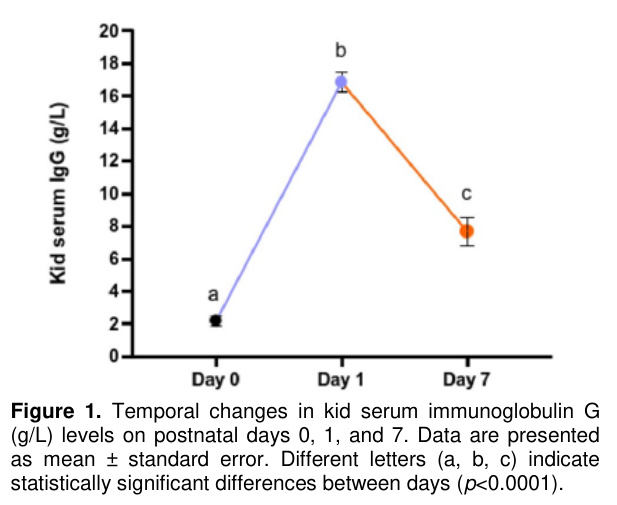
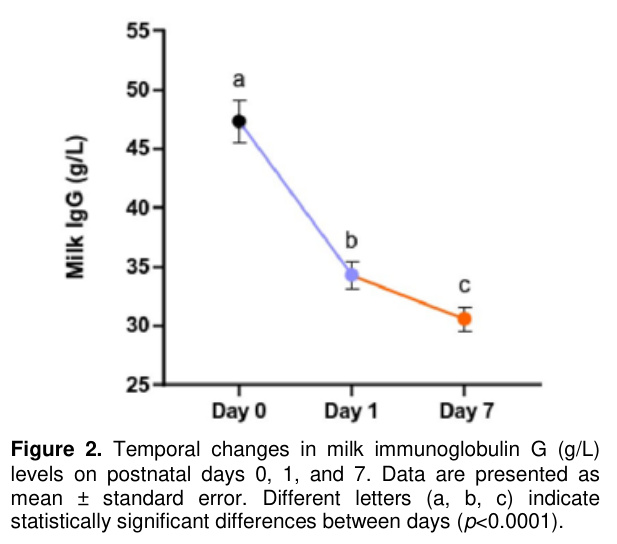
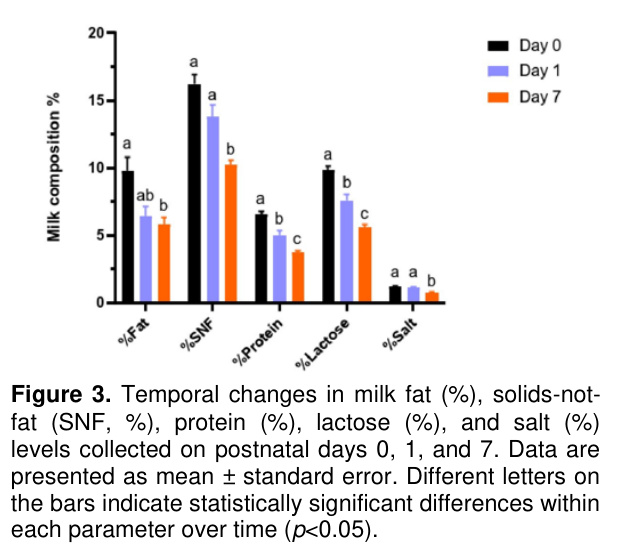
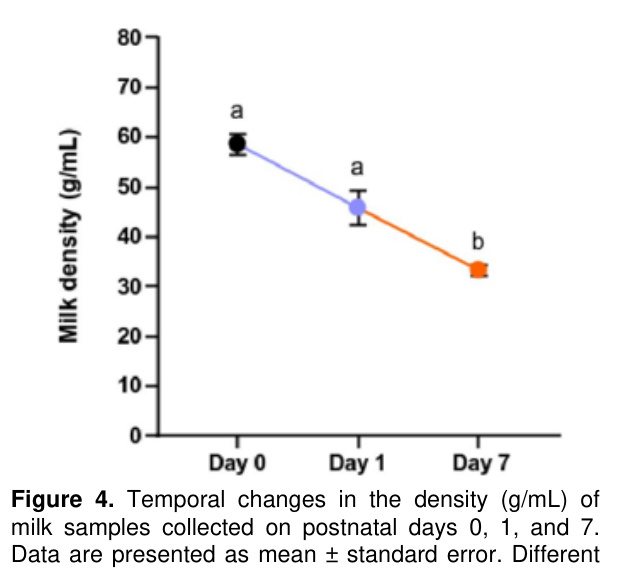
Table 1 presents the Pearson correlation analysis used to evaluate the relationships between IgG concentration and milk composition parameters (fat, non-fat dry matter, protein, lactose, and salt) in milk samples obtained on different postpartum days (days 0, 1, and 7). The correlation coefficients and statistical significance levels between IgG concentration and the examined milk composition parameters are presented in Table 1. A statistically significant positive correlation was observed between milk IgG and salt content on day 7 (r=0.7859, p=0.0208), whereas no statistically significant relationships were observed with the other parameters across any of the evaluated time points (p>0.0551; Table 1).
Table 2 shows the Pearson correlation analysis used to evaluate the relationships between serum IgG concentrations of kids on postnatal days 0, 1, and 7 and the compositional parameters of goat milk. The correlation coefficients (r) and statistical significance levels between serum IgG concentration and milk composition parameters are presented in Table 2. No statistically significant relationships were observed between kid serum IgG and milk composition parameters across the evaluated time points (all p>0.07; Table 2).
Table 3 shows the Pearson correlation analysis analysis used to evaluate the relationship between milk IgG concentration and serum IgG concentrations in kids on postnatal days 0, 1, and 7. The correlation coefficients (r) and statistical significance levels between milk IgG concentration and kids serum IgG levels are presented in Table 3. The analysis revealed no statistically significant correlation between milk IgG concentration and kid serum IgG concentration across the evaluated time points (day 0: r=-0.0969, p=0.8195; day 1: r=-0.6767, p=0.0653; day 7: r=-0.1023, p=0.8094; Table 3).
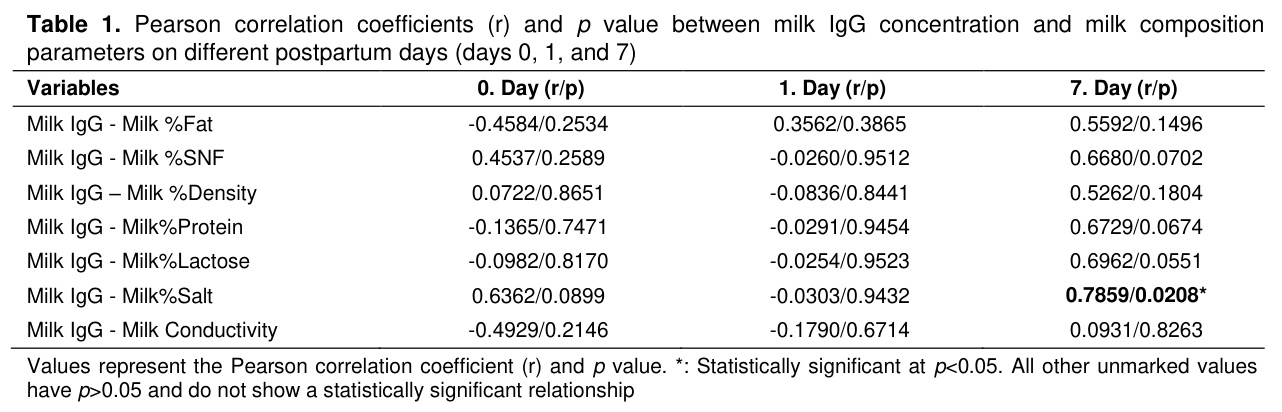
Values represent the Pearson correlation coefficient (r) and p value. *: Statistically significant at p<0.05. All other unmarked values have p>0.05 and do not show a statistically significant relationship
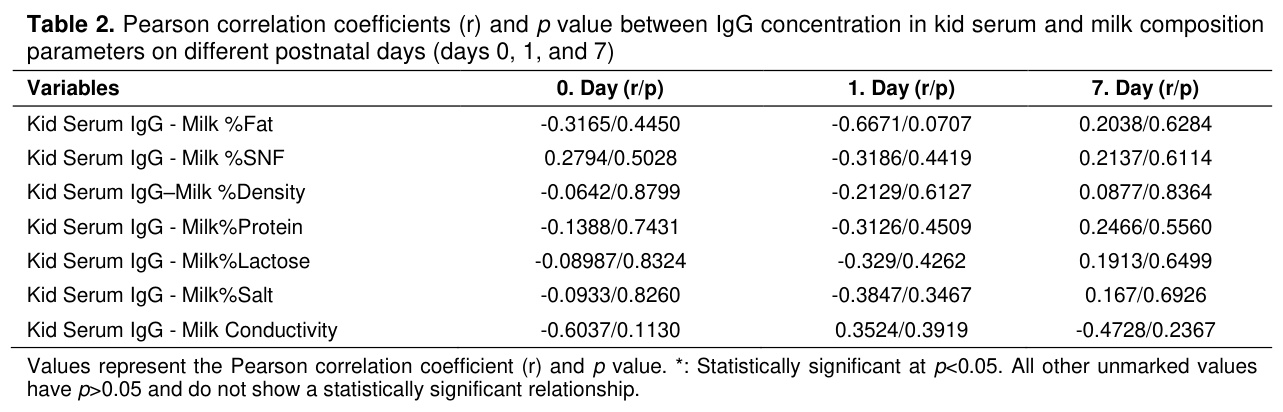
Values represent the Pearson correlation coefficient (r) and p value. *: Statistically significant at p<0.05. All other unmarked values have p>0.05 and do not show a statistically significant relationship.

Values represent the Pearson correlation coefficient (r) and p value. *: Statistically significant at p<0.05. All other unmarked values have p>0.05 and do not show a statistically significant relationship.
Discussion
Colostrum intake is of great importance for viability and passive immunity development in newborn animals. Therefore, it is essential that the kids receive sufficient colostrum, especially immediately after parturition [10]. However, the quantity and composition of colostrum produced by mothers are influenced by various environmental factors, including nutrition and the number of kids per parturition [11]. Another important issue is reduced viability due to insufficient colostrum intake in the first few hours after parturition, which can lead to increased mortality rates [12]. Therefore, ensuring the most suitable source of colostrum is of great importance. For this reason, colostrum specific to each species may be provided to ensure easy transfer of immunoglobulins to the kids [13]. The most significant changes in immunoglobulin levels occur in IgG and IgM. The mortality rate of goat kids is closely related to the level of IgG in the blood [14].A decrease in IgG concentration is expected over time. The kids reach maximum IgG concentration between 16 and 48 hours after ingesting colostrum. Subsequently, the IgG concentration in colostrum decreases over time, and due to the transfer of IgG from colostrum to milk, the IgG concentration in the kids also decreases. In a study conducted by Rodriquez et al. [15] IgG, IgM, and IgA concentrations were examined. They found these concentrations to be 40.0, 1.9, and 0.8 mg/ml, respectively, and reported that IgG showed a rapid decrease at 10 hours. In this study, the average IgG concentration, which was 47 mg/ml on the first day, decreased to 32 mg/ml at 24 hours. Similarly, Moreno et al. [14] monitored IgG concentration over a 10-hour period in a study they conducted. It was observed that the concentration, which was high in the first 3 hours, gradually decreased in the following hours. In a study conducted by Batmaz et al. [16] they found that the highest rate of Passive Transfer Failure (PTF) was observed on Day 1, and that lower rates of PTF were seen on Days 2 and 3, depending on the time of observation. In our study, IgG concentration decreased over time. However, in the kid, the IgG concentration, which was low on day 0, increased 24 hours after colostrum intake.
Rodriquez et al. [15] reported that in their studies on kids, IgG concentrations showed a peak increase on day 1, followed by a decrease, with the lowest concentration on day 0. The results from Argüello et al. [17] and Castro et al. [18] are consistent with this study. In our study, concentrations were lowest on day 0 before colostrum intake in kids; they showed a rapid increase followed by a decrease on day 7.
Uztimur et al. [19] reported in a study on Angora goats that IgG concentrations were higher in goats giving parturition to twins and in those with a high number of parturitions compared to those giving parturition for the first time or in those giving parturition to a single child. While some studies support this information [20,21], other studies have found no correlation between lactation number and colostrum IgG concentration [22,23]. In our study, IgG concentrations were found to be high. This may be because we selected animals that gave parturition to twins and were in their second or third lactation.
A study conducted in Murcia–Granada goats reported significant postpartum changes in several milk components during the first 96 h after kidding, with decreases in IgG, protein, and non-fat solids, whereas lactose increased over time; fat concentration was not significantly affected by postpartum day [24]. Similarly, Mehra et al. [25] reported that fat, dry matter, SNF, and IgG concentrations were higher in colostrum and decreased progressively with time. Consistent with these findings, our study also demonstrated a time-dependent decrease in milk composition and IgG concentrations during the early postpartum period. However, no significant correlation was observed between milk composition parameters and IgG concentration in our study.
Conclusion
In conclusion, this study demonstrated that colostrum IgG concentration decreased during the postpartum period, whereas kid serum IgG concentration increased during the first 24 h following colostrum intake. However, no consistent relationship was observed between milk IgG concentration and kid serum IgG concentration or between milk composition parameters and IgG concentration. These results provide preliminary information on the postpartum dynamics of IgG in colostrum, milk, and kid serum in Murciano-Granadina goats. Further studies with larger sample sizes are warranted to provide a more comprehensive assessment of these relationships.References
- Kessler EC, Bruckmaier RM, Gross JJ. Immunoglobulin G content and colostrum composition of different goat and sheep breeds in Switzerland and Germany. J Dairy Sci 2019; 102: 5542-5549.
- Pérez-Marín CC, Cano D, Arrebola FA, et al. Colostrum Quality Assessment in Dairy Goats: Use of an On-Farm Optical Refractometer. Biol 2023; 12: 626.
- Levieux D, Morgan F, Geneix N, Masle I, Bouvier F. Caprine immunoglobulin G, β-lactoglobulin, α-lactalbumin and serum albumin in colostrum and milk during the early post partum period. J Dairy Res 2002; 69: 391-399.
- Chase CCL, Hurley DJ, Reber AJ. Neonatal immune development in the calf and its impact on vaccine response. Vet Clin North Am Food Anim Pract 2008; 24: 87-104.
- Cortese VS. Neonatal immunology. Vet Clin North Am Food Anim Pract 2009; 25: 221-227.
- Kessler EC, Bruckmaier RM, Gross JJ. Short communication: Comparative estimation of colostrum quality by Brix refractometry in bovine, caprine, and ovine colostrum. J Dairy Sci 2021; 104: 2438-2444.
- Kaushik AK, Kandavel H, Nalpathamkalam T, Pasman Y. Bovine neonate is deficient in innate immunity at parturition. Mol Immunol 2021; 133: 101-109.
- Sánchez-Macías D, Moreno-Indias I, Castro N, et al. From goat colostrum to milk: Physical, chemical, and immune evolution from partum to 90 days postpartum. J Dairy Sci 2014; 97: 10-16.
- Castro N, Capote J, Morales-delaNuez A, Rodríguez C, Argüello A. Effects of newborn characteristics and length of colostrum feeding period on passive immune transfer in goat kids. J Dairy Sci 2009; 92: 1616-1619.
- Hernandez D, Nydam DV, Godden SM, et al. Brix refractometry in serum as a measure of failure of passive transfer compared to measured immunoglobulin G and total protein by refractometry in serum from dairy calves. Vet J 2016; 211: 82-87.
- Besser TE, Gay CC. The importance of colostrum to the health of the neonatal calf. Vet Clin North Am Food Anim Pract 1994; 10: 107-117.
- Quigley JD, Drewry JJ. Nutrient and immunity transfer from cow to calf pre- and postcalving. J Dairy Sci 1998; 81: 2779-2790.
- Korhonen H, Pihlanto-Leppäla A, Rantamäki P, Tupasela T. Impact of processing on bioactive proteins and peptides. Trends Food Sci Technol 1998; 9: 307-319.
- Moreno-Indias I, Sánchez-Macías D, Castro N, et al. Chemical composition and immune status of dairy goat colostrum fractions during the first 10 h after partum. Small Rum Res 2012; 103: 220-224.
- Rodríguez C, Castro N, Capote J, et al. Effect of colostrum immunoglobulin concentration on immunity in majorera goat kids. J Dairy Sci 2009; 92: 1696-1701.
- Batmaz H, Kaçar Y, Topal O, et al. Evaluation of passive transfer in goat kids with Brix refractometer and comparison with other semiquantitative tests. Turk J Vet Anim Sci 2019; 43: 596-602.
- Argüello A, Castro N, Zamorano MJ, Castroalonso A, Capote J. Passive transfer of immunity in kid goats fed refrigerated and frozen goat colostrum and commercial sheep colostrum. Small Rum Res 2004; 54: 237-241.
- Castro N, Capote J, Morales L, et al. Short communication: Addition of milk replacer to colostrum whey: Effect on immunoglobulin G passive transfer in majorera kids. J Dairy Sci 2007; 90: 2347-2349.
- Uztimür M, Keçeci H, Ünal CN. Evaluation of the relationship between colostrum quality and lactation number in dairy hair goats. Etlik Veteriner Mikrobiyoloji Dergisi 2025; 36: 22-26.
- Kaçar Y, Mecitoğlu Z, Topal O, Batmaz H. Comparison of four semi-quantitative tests for evaluation of colostrum quality in Saanen goats. SA J An Sci 2022; 51: 657-663.
- Romero T, Beltrán MC, Rodríguez M, De Olives AM, Molina MP. Short communication: Goat colostrum quality: Litter size and lactation number effects. J Dairy Sci 2013; 96: 7526-7531.
- Turquino CF, Flaiban KKMC, Lisbôa JAN. Passive transfer of immunity in meat lambs reared in the tropics on extensive management. Pesq Vet Bras 2011; 31: 199-205.
- Argüello A, Castro N, Álvarez S, Capote J. Effects of the number of lactations and litter size on chemical composition and physical characteristics of goat colostrum. Small Rum Res 2006; 64: 53-59.
- Segura MM, Martínez-Miró S, López MJ, Madrid J, González V, Hernández F. The effect of the season on the time dependent changes in colostrum lactoferrin level in murciano–granadina goats in intensive system farming. Anim 2024; 14: 2580.
- Mehra R, Sangwan K, Garhwal R. Composition and therapeutic applications of goat milk and colostrum. Research & Reviews J Dairy Sci Technol 2021; 10: 1-7.
- KOYUN VE KEÇİLERDE BÖBREK HİDATİDOZİSİNİN İNSİDENS VE PATOLOJİSİ
- KAYSERİ YÖRESİNDE KOYUN VE KEÇİLERDE BABESİOSİS*
- ELAZIĞ ELET MEZBAHASINDA KESİLEN KOYUN VE KEÇİ MEMELERİ ÜZERİNDE PATOLOJİK İNCELEMELER
- ELAZIĞ’DA 1999 YILINDA KOYUN VE KEÇİLERDE GÖZLENEN PESTE DES PETİTS RUMİNANTS (PPR) OLGULARI
- KEÇİLERDE DİŞİ GENİTAL ORGAN BOZUKLUKLARI ÜZERİNDE MORFOLOJİK İNCELEMELER I. OVARYUM VE OVİDUKT*